


Kazakhstanis to witness several space phenomena at once in late July
Summarized and contextualized by DistantNews.
At a glance
News
Named sources
Context piece
- Kazakhstan will experience multiple astronomical events in late July, including the Buck Moon and two meteor showers.
- The Buck Moon will reach its peak on July 29, while the Southern Delta Aquariids and Alpha Capricornids meteor showers peak on July 30-31.
- Viewing conditions for the meteor showers will be poor due to bright moonlight, and the Delta Aquariids will be difficult to see at Kazakhstan's latitudes.
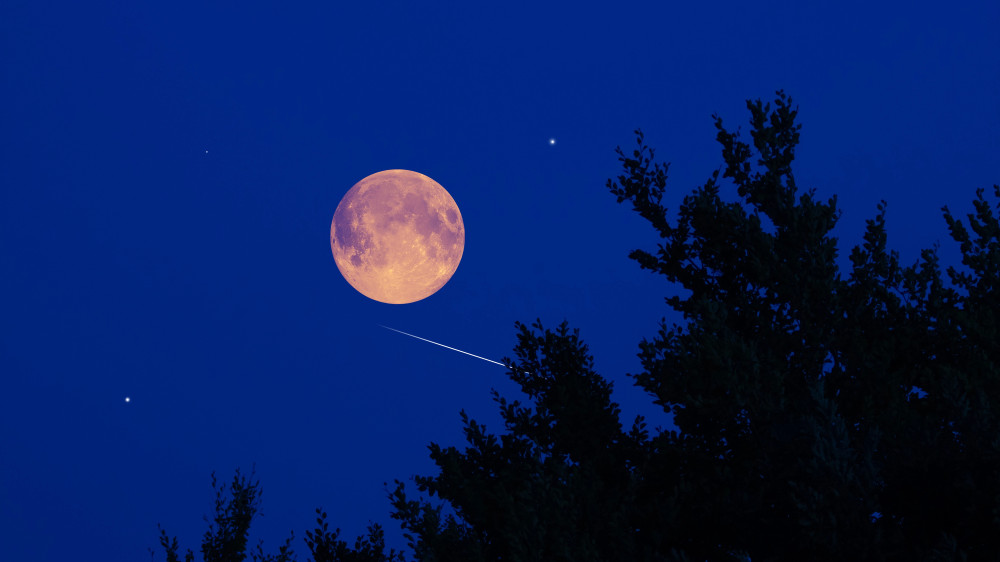
Kazakhstan is set to witness a celestial spectacle in late July, with the appearance of the Buck Moon and the peak of two significant meteor showers. The July full moon, traditionally known as the Buck Moon in North America for the growth of deer antlers, will reach its maximum phase on July 29 at 7:35 p.m. Astana time, according to the Fesenkov Astrophysical Institute.
In 2026, viewing conditions are poor, as the almost full and very bright Moon will interfere with observing the shower.
Adding to the cosmic display, the night of July 30 to 31 will see the simultaneous peak of the Southern Delta Aquariids and the Alpha Capricornids meteor showers. These events typically offer a dazzling array of fast meteors and bright fireballs. However, astronomers caution that viewing conditions this year will be far from ideal.
Specialists from the Fesenkov Astrophysical Institute noted that the "almost full and very bright Moon will interfere with observing the shower." The Southern Delta Aquariids, originating from Comet 96P/Machholz, are best observed in the Southern Hemisphere and at low northern latitudes, making them difficult to spot in Kazakhstan. Similarly, the Alpha Capricornids, known for their slow, spectacular fireballs and originating from Comet 169P/NEAT, will also be hampered by bright moonlight, particularly at Kazakhstan's latitudes.
Visibility conditions this year are also unfavorable. The shower is clearly visible in the Southern Hemisphere, while in our latitudes moonlight will make it difficult to observe.
Further enhancing the month's astronomical offerings, Comet 10P/Tempel 2 will be visible in the evening sky throughout July, though not to the naked eye. The comet will reach perihelion on August 2 and make its closest approach to Earth on August 3, 2026, at magnitude 6.9. It will be observable with binoculars or a telescope in both hemispheres.
The comet will pass perihelion on August 2, and its closest approach to Earth will occur on August 3, 2026, at magnitude 6.9. It can be observed in both the Southern and Northern Hemispheres only with binoculars or a telescope.
DistantNews Editorial
Originally published by Tengrinews. Summarized and contextualized by our editorial team with added local perspective. Read our editorial standards.
More Stories



From Our Blog

What Gets Lost (and Found) When News Is Translated

The Critical Role of Diaspora Media in Global News

What Travellers Should Know About Countries with Restricted Press

A Digital Nomad's Guide to Following Local News

How the Same Story Looks Different in Different Countries
