


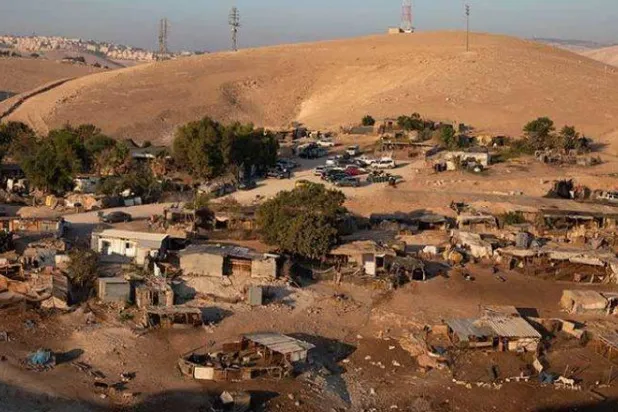
Khan al-Ahmar: The last tent in the battle for Greater Jerusalem
Translated from English, summarized and contextualized by DistantNews.
At a glance
News
Named sources
Ongoing story
- Israel's far-right government plans to annex Khan al-Ahmar and surrounding areas into Jerusalem under the controversial E1 project.
- This plan aims to create a settlement belt across the West Bank, isolating Jerusalem from Palestinian territories and ending the possibility of a contiguous Palestinian state.
- Residents of Khan al-Ahmar, facing demolition orders for years, express increased worry due to Israel's post-Oct. 7 aggression and the scattered Palestinian response.
The Bedouin community of Khan al-Ahmar, located in the West Bank, faces an intensified threat of demolition and annexation as part of Israel's controversial E1 project. The plan, championed by Israel's far-right government, seeks to incorporate Maale Adumim, Khan al-Ahmar, and surrounding lands into Jerusalem, creating a settlement bloc that would bisect the West Bank.
The situation this time is completely different and very dangerous.
This strategic move aims to solidify Israeli control by expanding settlements, effectively preventing the formation of a contiguous Palestinian state and isolating Jerusalem, which Palestinians envision as their future capital. Khan al-Ahmar, in particular, has been a focal point of resistance, with residents enduring numerous demolition orders and legal battles to hold onto their land and homes.
Eid al-Jahalin, known as Abu Khamis and head of the Bedouin council, conveyed a message of grave concern. He stated that the demolition of Khan al-Ahmar would pave the way for the "Greater Jerusalem" plan, describing the current situation as "completely different and very dangerous" compared to past threats. He noted a significant shift since the events of Oct. 7, observing increased Israeli aggression and a West Bank transformed into a "state of settlers."
In 2018, all Palestinians were with us. The government and civil society were sleeping here. I had 5,000 people with me. International pressure was strongly present, and our cause was at the top of the Middle East agenda. Today, the situation is different.
Abu Khamis lamented the fragmentation of the Palestinian response and the international community's diminished focus on the issue. He contrasted the present situation with 2018, when widespread Palestinian support and strong international pressure were present. Now, he feels the Palestinian effort is scattered, with "a thousand Khan al-Ahmars" facing destruction across the West Bank amidst ongoing conflict.
After Oct. 7, Israel became more aggressive, and the West Bank has been turned into a state of settlers. This is a state war against us, not a problem caused by individuals. In the West Bank, we now have a thousand Khan al-Ahmars: killing, displacement and fire consuming every part of the West Bank, while the Palestinian effort is scattered.
DistantNews Editorial
Originally published by Asharq Al-Awsat in English. Translated, summarized, and contextualized by our editorial team with added local perspective. Read our editorial standards.
More Stories


From Our Blog

What Gets Lost (and Found) When News Is Translated

The Critical Role of Diaspora Media in Global News

What Travellers Should Know About Countries with Restricted Press

A Digital Nomad's Guide to Following Local News

How the Same Story Looks Different in Different Countries
