


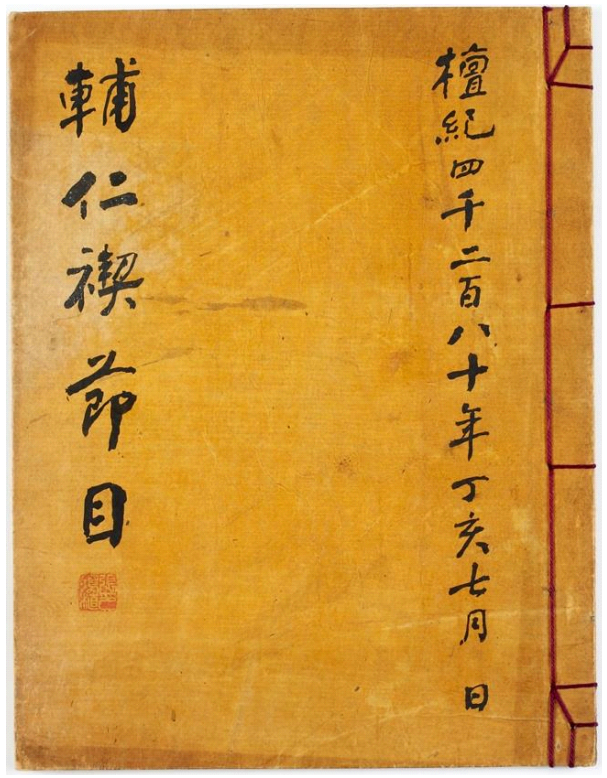
Kim Koo's handwriting potentially identified in documents from Provisional Government society 'Bo-in Gye'
Translated from Korean, summarized and contextualized by DistantNews.
At a glance
News
Official statement
Context piece
- Documents related to the 'Bo-in Gye,' a society formed by leaders of the Provisional Government of the Republic of Korea, may bear the handwriting of Kim Koo.
- The National Museum of Korean History confirmed the potential discovery of Kim Koo's handwriting in the 'Bo-in Gye Jeolmok' document.
- Experts are analyzing the unique brushstrokes and character structures in the document, which contains over 830 characters, to confirm the authenticity.
A significant discovery may shed new light on the legacy of Kim Koo, a pivotal figure in Korea's independence movement. Documents associated with the 'Bo-in Gye,' a society established by key figures of the Provisional Government of the Republic of Korea, are now believed to contain the personal handwriting of Kim Koo himself. The National Museum of Korean History announced that its analysis of the 'Bo-in Gye Jeolmok' (Rules of the Bo-in Gye) has revealed characteristics consistent with Kim Koo's known writing style. The 'Bo-in Gye' was formed in 1947 with the aim of fostering friendship and mutual aid among its members. The document in question details the society's operational regulations and bylaws. Experts are meticulously examining the document, which is notable for its length, containing over 830 characters. Specific features, such as the unique rendering of the characters for 'benevolence' (仁) and 'person' (人), are being scrutinized. Son Hwan-il, a researcher at the Calligraphy and Painting Culture Research Institute, noted that the distinctive brushstrokes, possibly influenced by a hand tremor developed after a gunshot injury, and the incomplete structure of some characters, strongly suggest Kim Koo's authorship. This potential confirmation of his handwriting in such a substantial document could offer fresh insights into his activities and associations during a crucial period of Korean history.
DistantNews Editorial
Originally published by Dong-A Ilbo in Korean. Translated, summarized, and contextualized by our editorial team with added local perspective. Read our editorial standards.
More Stories


From Our Blog

What Gets Lost (and Found) When News Is Translated

The Critical Role of Diaspora Media in Global News

What Travellers Should Know About Countries with Restricted Press

A Digital Nomad's Guide to Following Local News

How the Same Story Looks Different in Different Countries
