

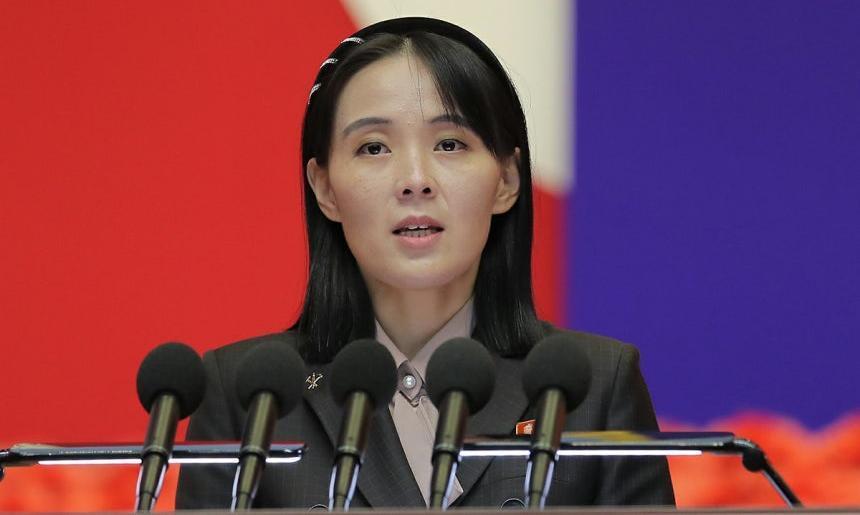

Kim Yo Jong frames global crises as interconnected, urges US to engage from position of parity
Translated from Korean, summarized and contextualized by DistantNews.
At a glance
News
Named sources
New plan
- North Korea's Kim Yo Jong issued a statement addressing global security issues, framing the US and its allies' actions within a broader Eurasian context.
- Her statement linked the Middle East, Ukraine war, North Korea-Russia cooperation, and Japan's military expansion as interconnected geopolitical challenges.
- Analysts suggest North Korea views the current international landscape as a unified theater of operations and seeks to negotiate with the US from a position of parity.
North Korean official Kim Yo Jong released a lengthy statement addressing global security concerns, strategically positioning the US and its allies' actions within a wider Eurasian geopolitical framework. While the statement touched upon the reduction of the South Korea-US joint military exercise 'Ulchi Freedom Shield' and Donald Trump, it dedicated a significant portion to broader international issues.
The recent international situation, which is becoming more unpredictable and complex, is amplifying geopolitical crises worldwide and causing serious concern for the international community desiring peace and stability.
Kim's statement began by acknowledging the unpredictable and complex international situation, which she argued amplifies geopolitical crises worldwide. She systematically outlined North Korea's stance on various regions, starting with the Middle East, described as a reflection of global conflict and chaos. She then addressed the escalating conflict in Ukraine, North Korea-Russia military cooperation (termed 'various cooperation between the DPRK and the Russian Federation'), and Japan's 'reckless military expansion attempts.'
Following this broad overview, Kim articulated North Korea's fundamental position: "We will always maintain a fundamental approach to remove threats and guarantee genuine peace and stability from a position of strong power, based on the unchanging reality that the greatest threat to the nation's security interests and regional security environment comes from the United States." Only after establishing this baseline did she specifically mention the US-ROK joint exercise and Trump, evaluating their relationship as "still excellent" but dismissing the exercise reduction as "not worth evaluating" and uninteresting.
We will always maintain a fundamental approach to remove threats and guarantee genuine peace and stability from a position of strong power, based on the unchanging reality that the greatest threat to the nation's security interests and regional security environment comes from the United States.
Analysts interpret Kim's approach as an attempt to frame North Korea-US relations not as a bilateral issue but as part of a larger Eurasian security dynamic. Kim Dong-yeop, a professor at the Institute for North Korean Studies, noted that Pyongyang perceives the current international landscape as a single, interconnected battlefield. He explained that the statement links events in the Middle East, Europe, the Korean Peninsula, and Japan into a single narrative, reflecting an understanding where US and Western hegemonic military actions are seen as occurring simultaneously across these regions.
Pyongyang sees the current international situation as a single, interconnected battlefield.
Kim Yo Jong's statement signals North Korea's intent to engage with the US from a position of parity, asserting its role as a nuclear-armed state and strategic player leading the construction of a multipolar world. Rachel Minyoung Lee, a senior fellow at the Stimson Center, observed that this broad framework, starting from the Middle East and concluding with North Korea-US relations, places the bilateral relationship within a larger strategic context. This suggests that if improving relations with the US no longer offers the same strategic value to North Korea as it did in 2018-2019, the scope and purpose of any future Trump-Kim diplomacy could be significantly narrowed.
The striking aspect of Kim Yo Jong's 'position' is the broad framework it presents, starting from the Middle East and moving through Europe and the Russia-Ukraine war, Japan, and South Korea-US joint exercises before concluding with North Korea-US relations.
DistantNews Editorial
Originally published by Hankyoreh in Korean. Translated, summarized, and contextualized by our editorial team with added local perspective. Read our editorial standards.
More Stories



From Our Blog

What Gets Lost (and Found) When News Is Translated

The Critical Role of Diaspora Media in Global News

What Travellers Should Know About Countries with Restricted Press

A Digital Nomad's Guide to Following Local News

How the Same Story Looks Different in Different Countries
