

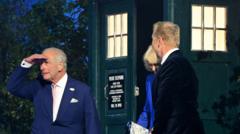
King's Tardis entrance as Commonwealth Games begin
Summarized and contextualized by DistantNews.
At a glance
News
Sources not specified
New plan
- The Commonwealth Games have begun in Glasgow with a vibrant opening ceremony featuring theatrical performances and music.
- The ceremony celebrated Glasgow and the Commonwealth, with notable moments including the entrance of the Falklands Islands and Samoa teams, and a large reception for the Scotland team.
- Despite initial uncertainty about hosting after Victoria withdrew, Glasgow stepped in to ensure the Games proceeded, repurposing venues from the 2014 event.
Glasgow has officially opened the Commonwealth Games with a spectacular ceremony that blended theatrical performances, music, and a strong sense of local pride. The event, held indoors for an intimate audience of approximately 10,000 people, marked a significant moment for the city, which stepped in to host after Victoria, Australia, withdrew its bid.
The ceremony was a "love letter to Glasgow and the Commonwealth," beginning with a performance by Scottish singer Nathan Evans and a dance beneath a replica of Glasgow Central Station's iconic clock. The atmosphere intensified with singer Callum Beattie's rendition of "Yes Sir, I Can Boogie," which had Scottish athletes dancing in their seats. The entrance of various teams drew cheers, with the Falklands Islands and Samoa teams receiving warm welcomes. However, the loudest applause was reserved for the Scotland team, who entered last in traditional attire.
A large representation of the Loch Ness Monster made an appearance, followed by a rousing performance of "Flower of Scotland" accompanied by bagpipers and drummers. Later in the evening, singer KT Tunstall performed "No Scotland No Party," another anthem associated with the Tartan Army. The King's Baton was also brought into the arena, accompanied by Nina Nesbitt's performance of The Proclaimers' classic "I'm Gonna Be (500 Miles)."
When the future of these Games was uncertain, Glasgow didn't ask: 'Can we?' We asked: 'When do we get started?'
Commonwealth Sport president Donald Rukare praised Glasgow's "extraordinary legacy" and the city's willingness to host. George Black, chair of Glasgow 2026, highlighted the collective effort involved, stating, "When the future of these Games was uncertain, Glasgow didn't ask: 'Can we?' We asked: 'When do we get started?'" He emphasized that venues, communities, businesses, artists, and volunteers all came together with the shared belief that the Commonwealth Games matter.
King Charles III, in his speech, stressed the importance of preventing plastic pollution in oceans and waterways, extending his gratitude to Glasgow and all involved in making the Games a reality. The Games feature eight fewer sports than in 2014 due to the short preparation time, and venues from the previous Glasgow event have been repurposed.
People across this city should be incredibly proud of what has been achieved over the past 18 months. Venues opened their doors. Communities opened their hearts. Businesses, artists, schools, volunteers, partners, neighbours and the people of Glasgow came together with one shared belief: that the Commonwealth Games matter and that the world deserves to experience them.
DistantNews Editorial
Originally published by BBC News. Summarized and contextualized by our editorial team with added local perspective. Read our editorial standards.
More Stories
From Our Blog

What Gets Lost (and Found) When News Is Translated

The Critical Role of Diaspora Media in Global News

What Travellers Should Know About Countries with Restricted Press

A Digital Nomad's Guide to Following Local News

How the Same Story Looks Different in Different Countries
