


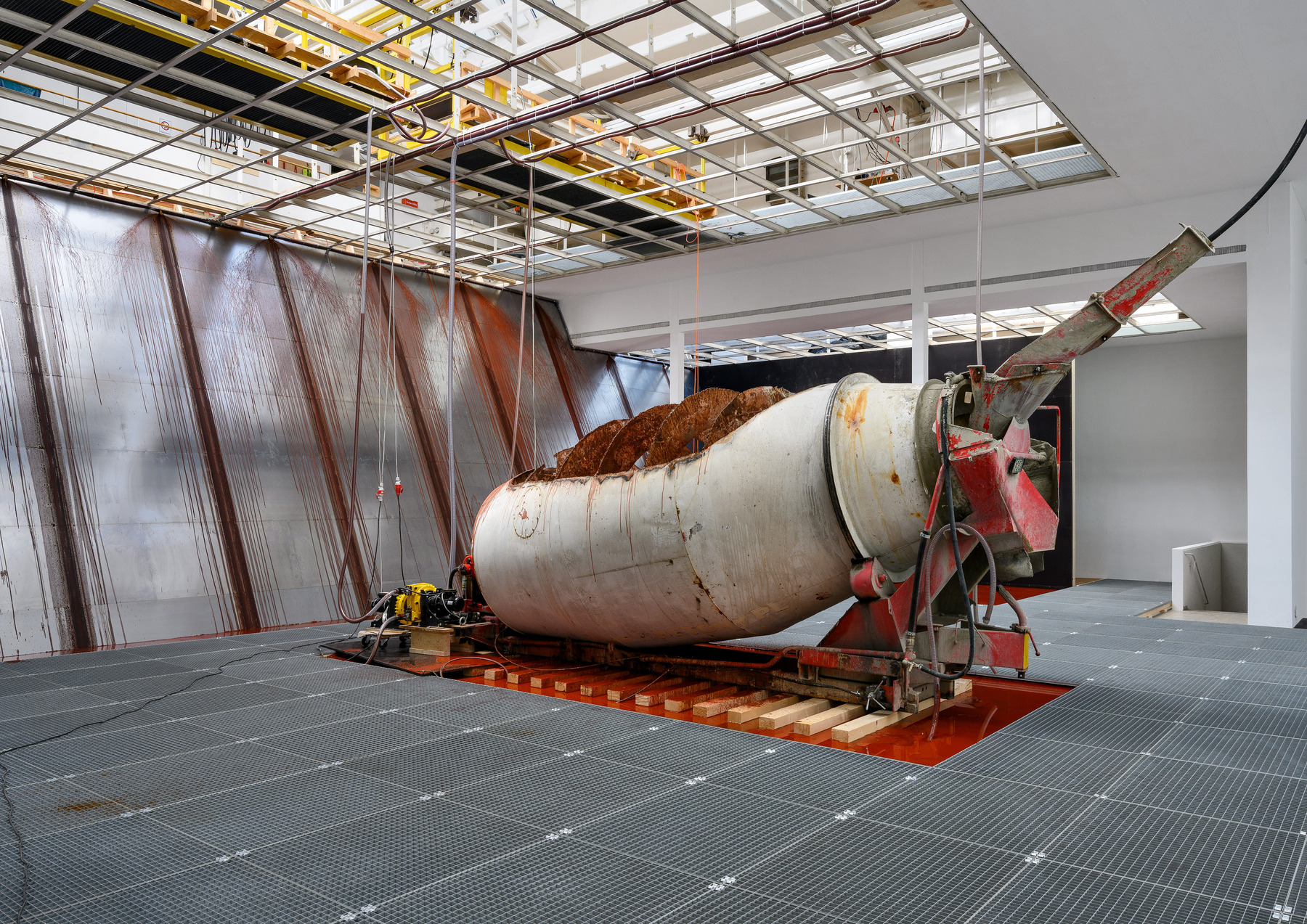
Korean artist Mire Lee injects 'blood' and gold into Vienna's Secession
Translated from German, summarized and contextualized by DistantNews.
At a glance
In-depth
Sources not specified
Context piece
- Korean artist Mire Lee transforms the Secession building in Vienna with a large, wounded cement mixer.
- The installation "reanimates" the space, referencing Gustav Klimt's "Golden Period" with gold dust mixed into a rust-colored fluid.
- The artwork explores themes of decay, bodily fluids, and art historical cycles, drawing parallels to Klimt, Hermann Nitsch, and Florentina Holzinger.
Korean artist Mire Lee has installed a striking, wounded cement mixer in the hallowed halls of the Vienna Secession, a space renowned for its modernist art. The machine, described as "reanimated" and "humanized" by Lee, features a cut-open drum from which a rust-colored fluid, mixed with gold dust, flows into a basin below. This fluid is then pumped to the ceiling, circulating through tubes that resemble veins, a visceral commentary on the building's architecture and the concept of the "White Cube."
The "White Cube," the neutral white space that we are accustomed to in museums today, was founded here in 1897. Here it is dissected in 2026 along with its juices, presenting our disgust and a dysfunctional and damaged circulatory system, making it appear almost human, at least sentient.
Lee, known for her large-scale installations, including one at Tate Modern last year, uses this piece to engage with the Secession's legacy, particularly its founder Gustav Klimt. The gold dust in the rust-colored fluid is a direct nod to Klimt's "Golden Period," offering a distinctly feminine interpretation of his iconic style. The artwork also evokes Hermann Nitsch's performance art and Florentina Holzinger's recent "industrialization" of such actions, highlighting a continuous, albeit artificially animated, art historical dialogue.
The installation further probes themes of decay, bodily fluids, and psychological states, referencing psychoanalyst Julia Kristeva's writings on disgust, horror, and melancholy. The "black sun" motif, an old exhibition title of Lee's, suggests a connection to the ancient concept of black bile, believed to influence mood and temperament. Lee's work dissects the traditional museum space, presenting a dysfuntional, wounded circulatory system that appears almost lifelike.
Mire Lee is interested here, like many Koreans, who make up a large part of the Belvedere Kiss tourists, in Gustav Klimt, founder of the Secession.
Adjacent to the main installation, Lee offers another homage to Klimt with her interpretation of the Beethoven Frieze, incorporating white, lead, and gold elements alongside fragmented text. The exhibition, which runs until August 30th, invites viewers to contemplate the intersection of art history, the body, and psychological states within a historically significant artistic venue.
Perhaps with the gold-infused rust-red, it is the juice of black bile that is meant, which in antiquity was responsible for the sentimental darkening of the spirit.
DistantNews Editorial
Originally published by Die Presse in German. Translated, summarized, and contextualized by our editorial team with added local perspective. Read our editorial standards.
More Stories



From Our Blog

What Gets Lost (and Found) When News Is Translated

The Critical Role of Diaspora Media in Global News

What Travellers Should Know About Countries with Restricted Press

A Digital Nomad's Guide to Following Local News

How the Same Story Looks Different in Different Countries
