


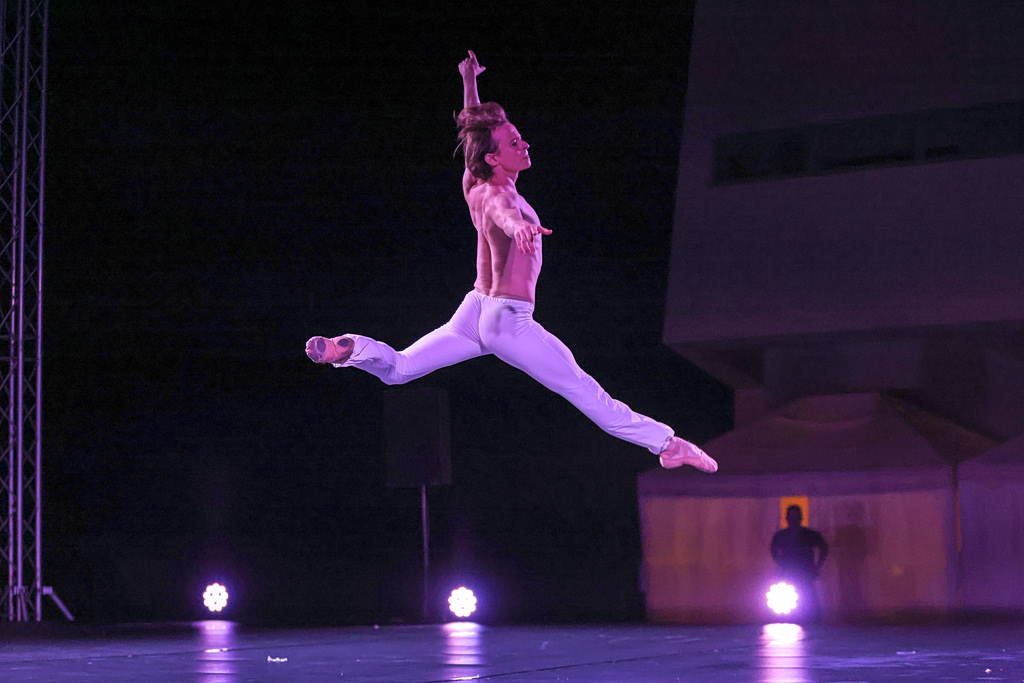
Korybantes descend from Mount Ida for Eleutherna museum's 10th anniversary performance
Translated from Greek, summarized and contextualized by DistantNews.
At a glance
In-depth
Sources not specified
Context piece
- The archaeological museum of Eleutherna celebrated its 10th anniversary with a performance titled "Coyrbantes," inspired by ancient Greek myth.
- Choreographed by Andrey Kaydanovskiy and performed by Daniel Simkin and others, the piece was a site-specific creation for the museum's surroundings.
- Simkin aimed to create a modern work that converses with myth without copying it, emphasizing the space and its history as integral to the performance.
The mythical Korybantes, ancient spirits from Mount Ida, descended from the peaks of Psiloritis last Friday and Saturday to celebrate the 10th anniversary of the archaeological museum of Eleutherna. They were the protagonists of the performance "Coyrbantes," a new work commissioned by the museum and its director, Professor Nikos Stampolidis, and created by Studio Simkin.
He told me that my dancing reminded him of the myth of the origin of dance in ancient Greece, the myth of the Korybantes.
Following the performance's world premiere in the open space surrounding the museum, Daniel Simkin, the internationally acclaimed dancer and the soul of the project, spoke about the commission. He performed the new work on a specially constructed stage alongside Maria Kochetkova, Rebeka Horner, and Tess Felker. The collaboration began three years ago after Simkin's performance of "Don Quixote" at the Greek National Opera, where he met Professor Nikos Stampolidis.
"He told me that my dancing reminded him of the myth of the origin of dance in ancient Greece, the myth of the Korybantes," Simkin recounted. "It was a narrative that deeply moved me and became the starting point for everything that followed." This meeting sparked a friendship and later led to the proposal for a work specifically for Eleutherna.
It was a narrative that deeply moved me and became the starting point for everything that followed.
Simkin expressed his passion for site-specific productions, which allow the space, its history, and its memory to become part of the creation. "Usually, dance is presented on a stage, within a neutral environment. Here, the exact opposite happened. The archaeological site, the museum, the landscape, the natural light, even the moon, were elements that co-shaped the performance," he said. He acknowledged the challenge of working with uncontrollable elements but noted that they make a live performance unique.
The archaeological site, the museum, the landscape, the natural light, even the moon, were elements that co-shaped the performance.
Simkin and his team visited the site in February to familiarize themselves with the archaeological site and museum. "We knew very well that we are not Greeks. That's why we had to be extremely careful. There is a fine line between paying homage and appropriating a culture. We did not want to imitate Greek tradition or re-enact ancient dances. We wanted to create a sincere contemporary work that converses with the myth without copying it," Simkin explained.
We knew very well that we are not Greeks. That's why we had to be extremely careful. There is a fine line between paying homage and appropriating a culture.
DistantNews Editorial
Originally published by Ta Nea in Greek. Translated, summarized, and contextualized by our editorial team with added local perspective. Read our editorial standards.
More Stories
From Our Blog

What Gets Lost (and Found) When News Is Translated

The Critical Role of Diaspora Media in Global News

What Travellers Should Know About Countries with Restricted Press

A Digital Nomad's Guide to Following Local News

How the Same Story Looks Different in Different Countries
