


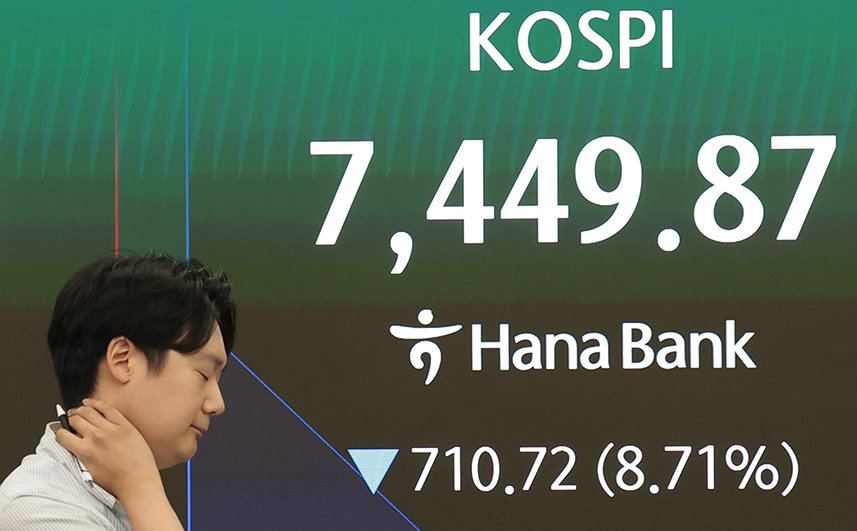
KOSPI Plummets Below 7,500, Circuit Breaker Triggered Amid Market Turmoil
Translated from Korean, summarized and contextualized by DistantNews.
At a glance
News
Named sources
Ongoing story
- The KOSPI index plummeted over 8% in early trading, triggering a circuit breaker.
- The sharp decline was attributed to concerns over US interest rate hikes and a slump in semiconductor stocks on Wall Street.
- The won-to-dollar exchange rate also surged to its highest level since March 2009.
South Korea's main stock market index, the KOSPI, experienced a dramatic plunge on June 8, 2026, falling below the 7,500-point mark and triggering a circuit breaker. The market's sharp decline, dubbed 'Black Monday,' was largely influenced by anxieties surrounding potential interest rate hikes by the U.S. Federal Reserve and a significant sell-off in semiconductor stocks, including Nvidia and Micron, on the New York Stock Exchange the previous week.
According to the Korea Exchange, the KOSPI dropped by 683.13 points, or 8.37%, to trade at 7,477.46 shortly after the market opened. The index had begun the day down 1.38% at 8,048.09, but the losses accelerated rapidly. The Korea Exchange activated the circuit breaker at 9:03:42 AM, a mechanism designed to halt trading temporarily when the market experiences significant, rapid declines.
The circuit breaker system is implemented in stages: if the KOSPI or KOSDAQ indices fall by 8%, 15%, or 20% or more from the previous day's closing price and sustain the drop for one minute, trading is suspended for 20 minutes or until the market closes, depending on the severity of the fall.
Adding to the market's woes, the KOSDAQ index also saw a substantial drop, opening 4.27% lower at 959.61 points. Meanwhile, the won-to-dollar exchange rate commenced trading at 1,555.2 won, an increase of 16.1 won from the previous trading day's closing rate. This opening rate marked the highest since March 6, 2009, during the global financial crisis, further signaling investor unease.
DistantNews Editorial
Originally published by Dong-A Ilbo in Korean. Translated, summarized, and contextualized by our editorial team with added local perspective. Read our editorial standards.
More Stories


From Our Blog

What Gets Lost (and Found) When News Is Translated

The Critical Role of Diaspora Media in Global News

What Travellers Should Know About Countries with Restricted Press

A Digital Nomad's Guide to Following Local News

How the Same Story Looks Different in Different Countries
