


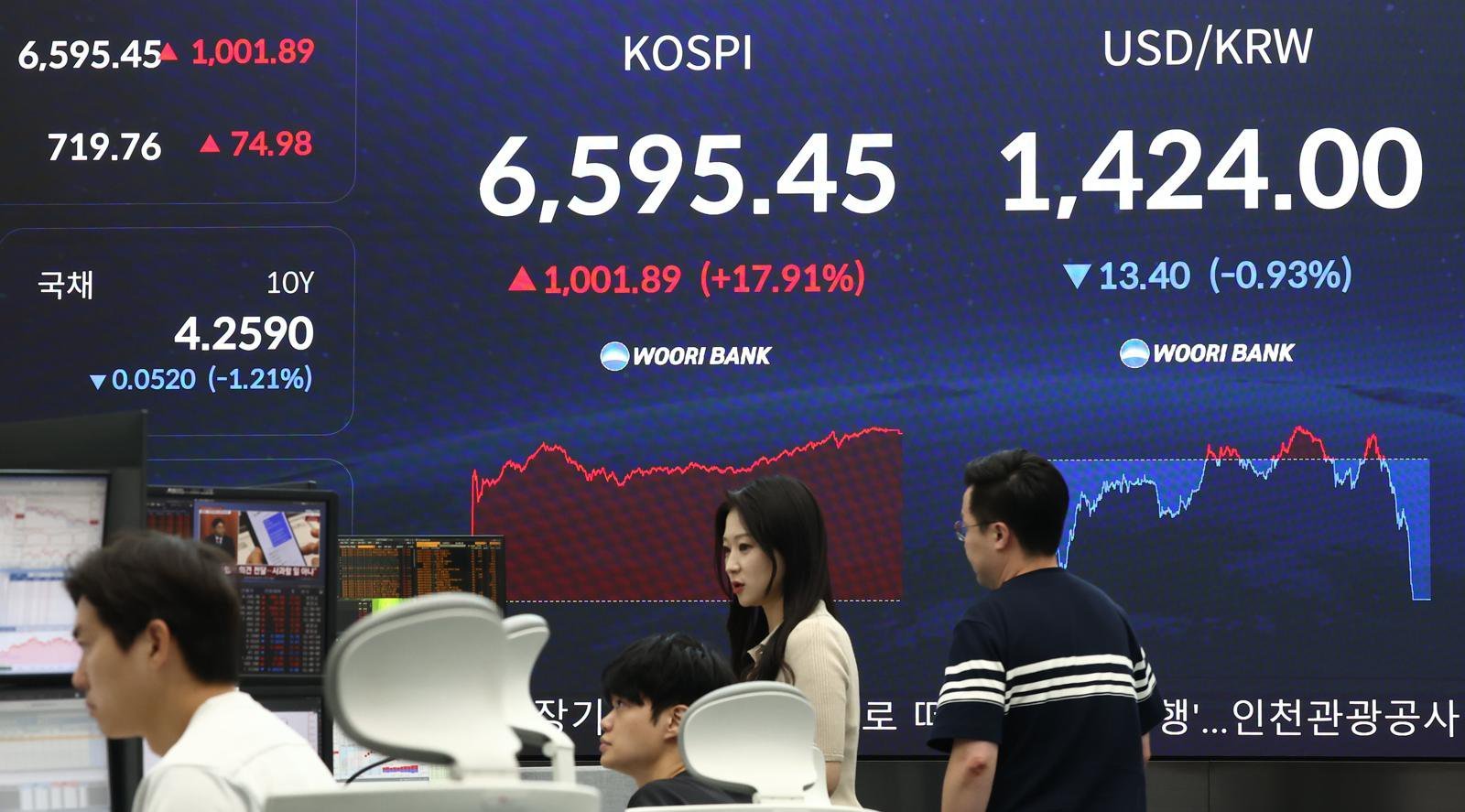
KOSPI's Record Surge Creates Mixed Fortunes for Investors Amid Semiconductor Boom
Translated from Korean, summarized and contextualized by DistantNews.
At a glance
News
Named sources
Outcome reported
- The South Korean stock market, KOSPI, experienced a record-breaking surge of 17.91% on July 31, driven primarily by semiconductor stocks.
- This dramatic rise created mixed fortunes for individual investors, with some profiting while others faced significant losses.
- Concerns were raised about the market becoming a speculative playground rather than reflecting economic growth, with warnings against excessive risk-taking.
The South Korean stock market, KOSPI, witnessed an unprecedented surge on July 31, closing at 6595.45 points, marking a record 17.91% increase in a single day. This dramatic rise was largely propelled by a significant rally in semiconductor stocks, including Samsung Electronics, which jumped 26.81%, and SK Hynix, up 29.95%.
I urgently need to recover my losses before the down payment deadline, but the market is volatile and getting a loan is becoming difficult.
The market's sharp ascent led to divergent outcomes for individual investors. While those who had anticipated a technical rebound and bought stocks the previous day reaped profits, many others who had sold during the downturn or faced margin calls suffered substantial losses. One investor, identified as Ms. Lee, a 40-year-old office worker, expressed distress over losing a portion of her apartment down payment due to a drop in SK Hynix shares, facing pressure to secure funds before her September payment deadline.
Investors who had leveraged their positions through margin trading, known as 'bitu' (investing with borrowed money), were particularly hard-hit. When stock prices fall below a certain threshold, securities firms can forcibly sell collateral shares to cover the debt. Investors in inverse products and 'gobbus' (products offering double the inverse return) experienced significant losses during the sharp market upturn.
If I had been able to join leverage today, I could have recovered a significant portion of my investment losses, but I missed the last train.
Adding to the volatility, some individual investors reported difficulties in accessing leverage products due to new regulations requiring a higher minimum deposit. Professor Kang Sung-jin of Korea University's economics department cautioned that the current market surge appears more akin to a speculative frenzy than a natural rise driven by economic growth. He advised investors to recognize the inherent risks and avoid excessive, risky investments.
The recent stock price increase is less a natural rise due to real economic growth and more a state where the stock market has become a speculative playground. Investors must recognize the risk that prices can fall as much as they rise and avoid reckless investments.
DistantNews Editorial
Originally published by Dong-A Ilbo in Korean. Translated, summarized, and contextualized by our editorial team with added local perspective. Read our editorial standards.
More Stories



From Our Blog

What Gets Lost (and Found) When News Is Translated

The Critical Role of Diaspora Media in Global News

What Travellers Should Know About Countries with Restricted Press

A Digital Nomad's Guide to Following Local News

How the Same Story Looks Different in Different Countries
