


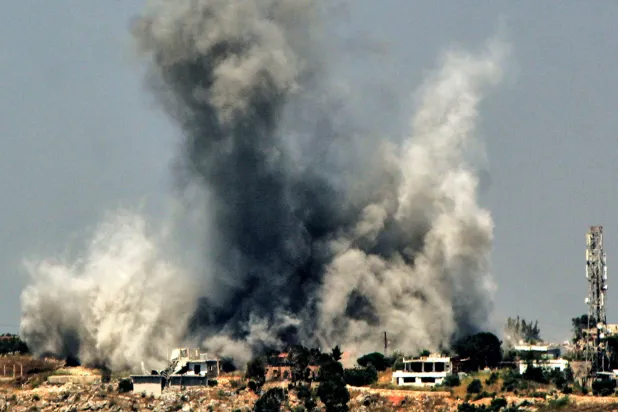
Lebanon Announces Partial Ceasefire between Israel, Hezbollah but Attacks Continue
Summarized and contextualized by DistantNews.
At a glance
News
Named sources
Ongoing story
- Lebanon announced a partial ceasefire between Hezbollah and Israel, aiming to de-escalate the conflict, though hostilities continue in southern Lebanon.
- The agreement, brokered with US involvement, calls for Israel to avoid strikes on Beirut and Hezbollah to halt attacks on Israel, but its full implementation remains uncertain.
- Iran has threatened to halt indirect peace talks with the US, citing the war in Lebanon, adding complexity to broader regional diplomatic efforts.
Lebanon announced a partial ceasefire on Monday, intended to de-escalate the conflict between Hezbollah and Israel. This move, described as a limited de-escalation, comes amid a broader US-Israeli war with Iran that has already claimed thousands of lives. However, the agreement's scope is limited, with Lebanon's embassy in Washington clarifying it would not end the conflict within the country. The core of the deal involves Israel refraining from strikes on Beirut and its Hezbollah-controlled suburbs, while the Iran-aligned group would cease its attacks on Israel.
Despite the announcement, hostilities persisted in southern Lebanon, where Israel has maintained an incursion for 25 years. Early Tuesday, the Israeli military reported intercepting projectiles from Lebanon into northern Israel, with no reported injuries. US President Donald Trump, who initially announced the agreement, stated that Hezbollah had pledged, through intermediaries, to halt attacks on Israel. Israeli Prime Minister Benjamin Netanyahu confirmed Israel would continue military operations in southern Lebanon, pushing towards the Zaharani River. Hezbollah lawmaker Hassan Fadlallah indicated the militia would support a full ceasefire across Lebanon as a precursor to Israeli troop withdrawal, without explicitly confirming a halt to strikes on Israel.
The ceasefire between Iran and the US is unequivocally a ceasefire on all fronts, including in Lebanon.
Lebanon plans to seek an expansion of the ceasefire in upcoming talks with Israel in Washington. This could potentially revive efforts to end the three-month-old war, which began with US and Israeli attacks on Iran. The peace process has been stalled for weeks under a fragile ceasefire, with negotiators struggling to agree on an initial framework. The Israel-Hezbollah war, which erupted on March 2 as an offshoot of the broader conflict, has become deeply entangled with it.
Adding another layer of complexity, Iran has threatened to halt its indirect peace negotiations with the US and potentially end a ceasefire that has largely held since early April, citing the war in Lebanon. While Iranian officials have not directly confirmed these reports, the stance signals a potential shift in regional diplomacy. President Trump, when asked about the peace talks, expressed indifference, stating they had become 'very boring.' The US designates Hezbollah as a terrorist organization, complicating any direct engagement.
The peace talks had 'started to get very boring' and that he did not care if they were over. 'I really don't care, I couldn't care less,'
DistantNews Editorial
Originally published by Asharq Al-Awsat. Summarized and contextualized by our editorial team with added local perspective. Read our editorial standards.
More Stories


From Our Blog

What Gets Lost (and Found) When News Is Translated

The Critical Role of Diaspora Media in Global News

What Travellers Should Know About Countries with Restricted Press

A Digital Nomad's Guide to Following Local News

How the Same Story Looks Different in Different Countries
