


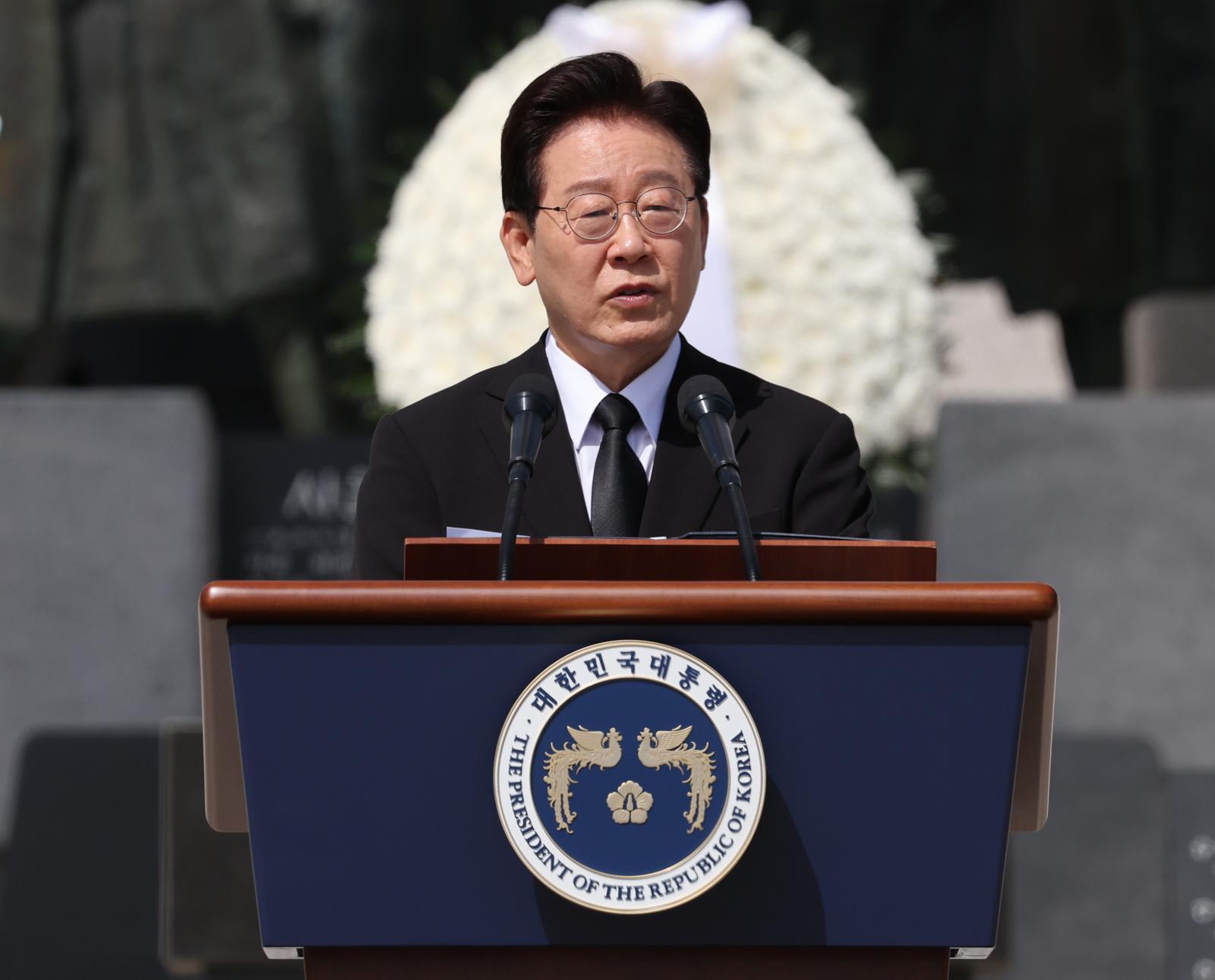
Lee: 'The Spirit of April 19 Defeated the Night of Internal Strife... Politics' Responsibility is Solely the People's Livelihood'
Translated from Korean, summarized and contextualized by DistantNews.
TLDR
- South Korean President Lee Jae-myung commemorated the 66th anniversary of the April 19 Revolution, emphasizing the enduring spirit of the uprising against dictatorship.
- He linked the 4.19 spirit to the nation's ability to overcome a "night of내란" (internal strife/rebellion) in December 2024, referencing the 12.3 emergency martial law.
- The president also highlighted the importance of prioritizing people's livelihoods and announced new commendations and enhanced support for veterans of the democratic movement.
On the 66th anniversary of the April 19 Revolution, President Lee Jae-myung delivered a powerful address at the National 4.19 Democratic Cemetery, drawing a direct line from the historic student-led uprising against authoritarianism to contemporary South Korean democracy. He asserted that the spirit of 4.19 was instrumental in overcoming a "night of internal strife" in December 2024, a veiled reference to the controversial 12.3 emergency martial law period, suggesting that the foundational democratic principles established in 1960 continue to safeguard the nation.
The spirit of the April 19 Revolution, which broke the chains of the formidable dictatorship and was born as the root of the Republic of Korea's Constitution, allowed us, the people of the Republic of Korea, to finally overcome the night of internal strife on the winter night of December 2024.
President Lee underscored the persistent struggle against authoritarianism, noting how the "heavy boots of dictatorship" exploit inequality and poverty to justify the suppression of democracy. This, he explained, is why he consistently emphasizes that "the responsibility of politics is solely the people's livelihood." He framed the 4.19 Revolution as a pivotal moment where the "resounding cry of national sovereignty" toppled an arrogant regime, serving as a beacon for democracy through subsequent historical struggles like the Busan-Masan Uprising, the May 18 Gwangju Democratization Movement, and the June Democracy Movement.
The heavy boots of dictatorship often exploit the cracks of inequality and poverty to justify the destruction of democracy. That is why I sometimes stubbornly say that the responsibility of politics is solely the people's livelihood, that the people's lives are the reason for the state's existence.
Reflecting on the sacrifices made for democracy, President Lee announced that his administration would newly honor seventy individuals, including five recognized at the ceremony, for their contributions to the nation's democratic development. He pledged to identify, commend, and honor every individual who sacrificed for democracy, including those from the 4.19 Revolution, and to strengthen medical support for elderly veterans. The president concluded by vowing to ensure that the spirit of 4.19, now a global heritage beyond the South Korean constitution, takes firm root in society and serves as a source of hope for future generations, reinforcing the narrative of a continuous struggle for democratic ideals deeply embedded in the national consciousness.
The bold courage of the citizens who rose up resolutely has become the lamp of democracy that has shown us the way at every crossroads of Korea's turbulent modern history.
DistantNews Editorial
Originally published by Dong-A Ilbo in Korean. Translated, summarized, and contextualized by our editorial team with added local perspective. Read our editorial standards.
More Stories


From Our Blog

What Gets Lost (and Found) When News Is Translated

The Critical Role of Diaspora Media in Global News

What Travellers Should Know About Countries with Restricted Press

A Digital Nomad's Guide to Following Local News

How the Same Story Looks Different in Different Countries
