


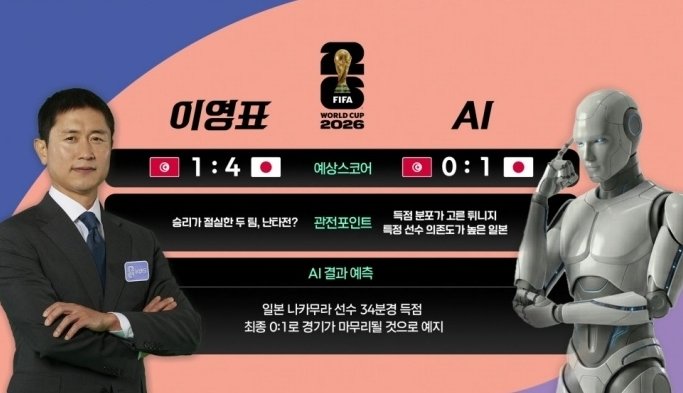
Lee Young-pyo Accurately Predicts Japan's 4-Goal Performance in World Cup Qualifier
Translated from Korean, summarized and contextualized by DistantNews.
At a glance
News
Sources not specified
Outcome reported
- Lee Young-pyo accurately predicted Japan's four-goal performance in their 4-0 victory over Tunisia in the 2026 FIFA World Cup qualifier.
- The former player expressed confidence in South Korea's upcoming match against South Africa, stating he wouldn't be envious if they played as well as Japan.
- Japan's victory marked the 1000th match in World Cup history, with Daichi Kamada scoring the inaugural goal.
Former South Korean national football player Lee Young-pyo accurately predicted Japan's dominant 4-0 victory over Tunisia in their second group stage match of the 2026 FIFA World Cup qualifiers. Lee had anticipated Japan would score four goals, a prediction that proved correct as Japan secured a decisive win.
The match held significance as it was the 1000th kickoff in World Cup history. Japan took an early lead just four minutes into the game with a goal from Daichi Kamada, followed by further goals from Ayase Ueda and Junya Ito. Ueda added a second goal later in the match, sealing Japan's largest-ever World Cup finals win.
I won't be envious. I expect our players to put on a performance just as brilliant as Japan's.
Despite Japan's impressive performance, Lee Young-pyo focused on South Korea's prospects. He stated, "I won't be envious. I expect our players to put on a performance just as brilliant as Japan's," expressing his hope for the South Korean team in their upcoming match against South Africa. He added that it must have been a difficult time for the Tunisian players, given the scoreline.
South Korea, led by coach Hong Myung-bo, was scheduled to play their final group stage match against South Africa on June 25th at the Monterrey Stadium in Mexico.
It must be a very painful time for the Tunisian players.
DistantNews Editorial
Originally published by Dong-A Ilbo in Korean. Translated, summarized, and contextualized by our editorial team with added local perspective. Read our editorial standards.
More Stories

"Look at Japan, we are a hastily assembled team".. Tunisia defender's sharp criticism of his nationa…

‘Crazy’ bases-loaded, no-out crisis: 3-pitch strikeout, 3-pitch strikeout, 3-pitch strikeout… 1st ro…
'Korea 0-4 Collapse, France 1-2 Loss' Wasn't a Coincidence... Côte d'Ivoire Almost Beat Germany Too!…
From Our Blog

What Gets Lost (and Found) When News Is Translated

The Critical Role of Diaspora Media in Global News

What Travellers Should Know About Countries with Restricted Press

A Digital Nomad's Guide to Following Local News

How the Same Story Looks Different in Different Countries
