


Library science graduates find new value in the AI era
Translated from Korean and summarized by DistantNews. Read the original for the full story.
At a glance
In-depth
Sources not specified
Context piece
- Graduates in library science, archival studies, and bibliography are in high demand due to their expertise in structuring data for AI models.
- Companies are seeking these professionals for roles like "Ontology FDE" to build knowledge graphs and manage complex data relationships essential for AI.
- Universities are responding by creating new programs, like Konyang University's "Data Medicine," to train specialists in medical data analysis and AI for healthcare.
In the age of artificial intelligence, traditional fields like library science, archival studies, and bibliography are experiencing an unexpected resurgence. Graduates from these disciplines are becoming "blue chips" in the job market, sought after for their crucial skills in organizing and structuring data. AI models require well-organized data to function effectively, and professionals trained in information classification, indexing, and retrieval are perfectly positioned to meet this need.
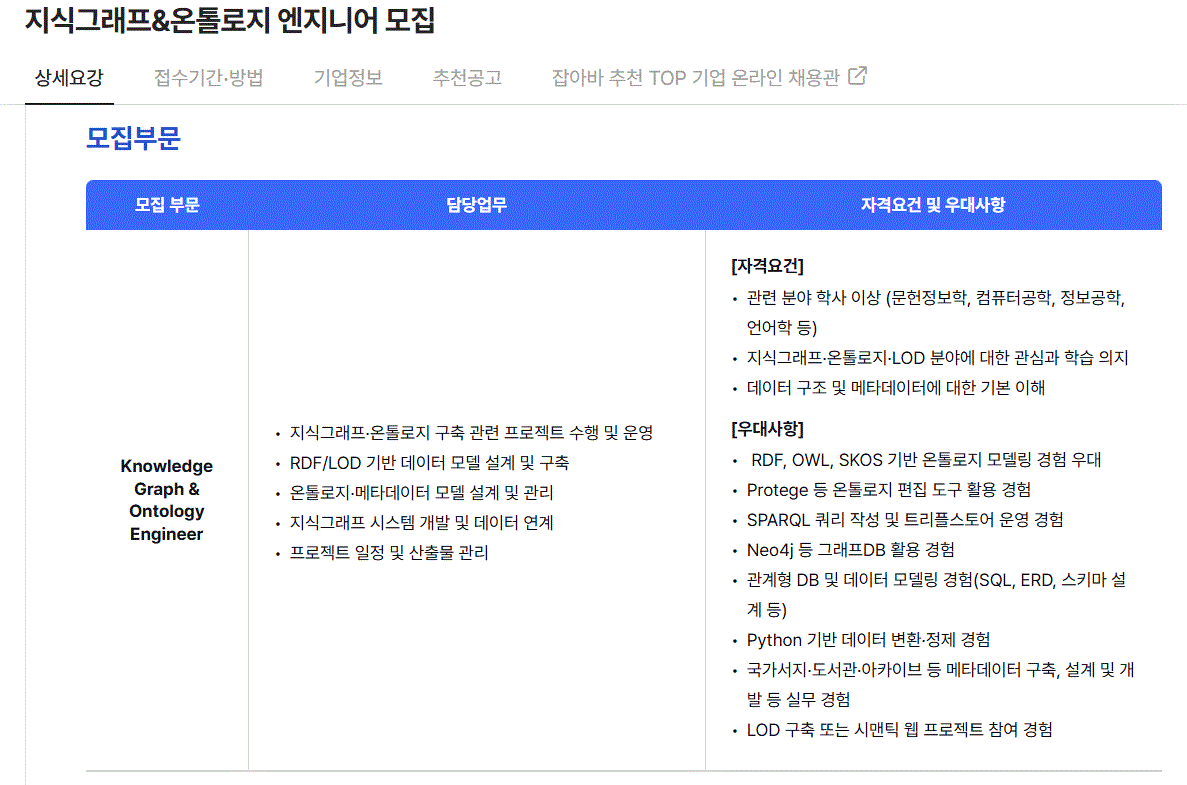
One of the core tasks of an Ontology FDE is to connect data and the relationships between data. The ability to understand and analyze the relationships between data from a user's perspective is important, and in that regard, we give preference to those with a library and information science background.
Companies specializing in AI are actively recruiting these graduates for roles that involve building complex data structures. For instance, AI firm Saltlux prioritizes library science and bibliography majors for its "Ontology FDE" (Forward Deployed Engineer) positions. These engineers are responsible for developing customized AI solutions in client environments, with a key task being to map the relationships between different data points. This requires an understanding of how users perceive and interact with data, a skill honed through library science education.
The core of this demand lies in the concept of "ontologies," which are defined as knowledge systems that pre-define the relationships between concepts. Unlike traditional database design, which focuses on data storage formats, ontology design emphasizes understanding the meaning of data and its interconnections. This is achieved by representing entities, attributes, and relationships in a structured format, often visualized as a knowledge graph. AI can then traverse this graph to make inferences, even without explicit programming for every scenario.
There is a vast amount of data in the industrial field that is not connected. We expect that library and information science majors can complement the limitations of existing computer science graduates when designing structures that can integrate such distributed data into a single ontology.
This growing need for data structuring expertise has prompted educational institutions to adapt. Konyang University, for example, has launched a pioneering "Data Medicine" department within its medical school. This program aims to cultivate specialists by integrating clinical medical knowledge with IT skills like big data analysis and bioinformatics, preparing graduates for roles in precision medicine, drug development, and digital healthcare. The university recognizes that traditional information science courses are insufficient to meet the industry's demands for advanced data analysis capabilities.
To create good medical AI models, we need good data, and the level of education provided in information science classrooms for a few hours is insufficient to develop the capabilities required by society.
About this summary
Originally published by Dong-A Ilbo in Korean. Translated, summarized, and contextualized automatically by DistantNews, with a note on how the source frames the story. Not individually reviewed before publishing. How this works.
More Stories

From Our Blog

What Gets Lost (and Found) When News Is Translated

The Critical Role of Diaspora Media in Global News

What Travellers Should Know About Countries with Restricted Press

A Digital Nomad's Guide to Following Local News

How the Same Story Looks Different in Different Countries
