


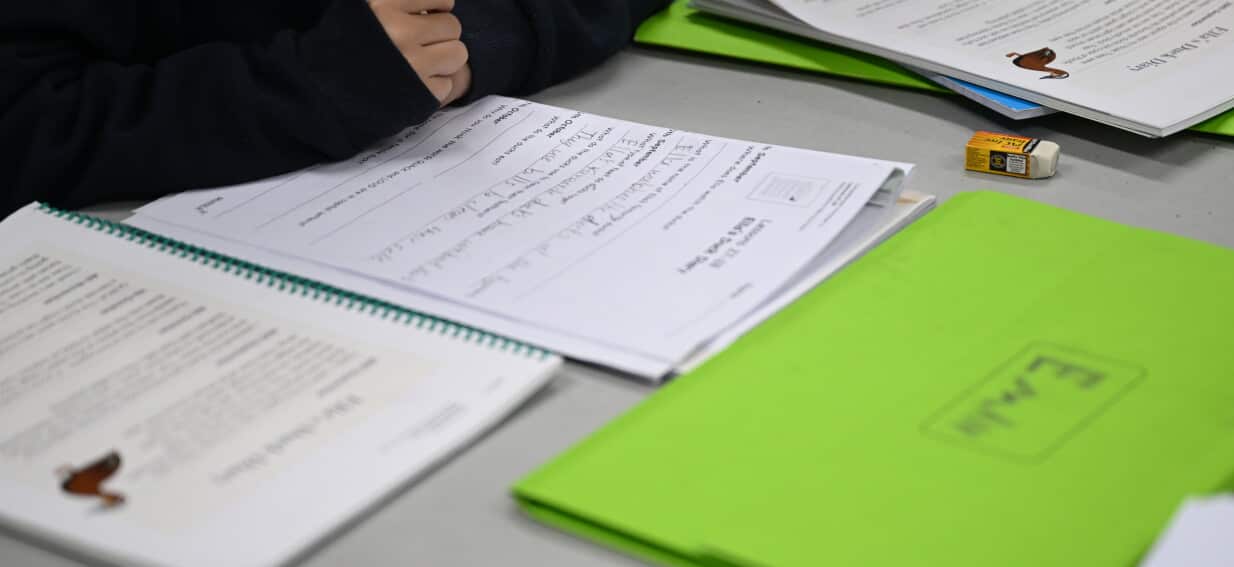
Low-income families call for support as national reading, writing school results slip
Summarized and contextualized by DistantNews.
At a glance
News
Named sources
Context piece
- One in three Australian students missed basic NAPLAN literacy and numeracy benchmarks in 2026, with reading scores declining across all year levels.
- Families of students needing extra support find the results demoralizing, highlighting a gap between academic performance and individual improvement.
- Experts and advocates call for better support systems, emphasizing the need to consider skills beyond academics and address the needs of low-income families.
National assessment results reveal a concerning trend, with one in three Australian students failing to meet basic literacy and numeracy benchmarks in 2026. Reading scores have notably declined across all year levels, exacerbating existing concerns about educational standards.
For families like Ruby's, the release of the National Assessment Program, Literacy and Numeracy (NAPLAN) results can be a source of significant distress. Her 11-year-old son, Mark, who has ADHD and autism and requires additional school support, found himself in the lowest performance category for reading, despite his efforts to improve. "I just thought to myself, 'How could it be right at the bottom when he's improved so much?'" Ruby questioned, expressing frustration over the disconnect between his progress and the standardized assessment outcome.
In his reading column ... it actually said the bottom, bottom. I just thought to myself, 'How could it be right at the bottom when he's improved so much?'
While writing ability saw a slight improvement among Year 5 students, it was the only cohort to do so. Overall, approximately 33% of students across all tested grades fell into the 'developing' and 'needs additional support' categories. Writing scores were particularly low in the two youngest tested grades, with fewer than 10% of students exceeding national benchmarks.
With 72,000 low-income students across Australia, the right support at the right time can make a huge difference.
Numeracy results showed improvement for most cohorts compared to 2025, though Year 3 scores decreased. The persistent literacy divide between students from affluent backgrounds and those from low socio-economic areas remains a significant issue. Ruby, who also faced learning challenges in a less supportive school environment, now raises her children on a low income and wishes for more school-based assistance for Mark.
Doug Taylor, CEO of The Smith Family, stressed the importance of timely and appropriate support for the 72,000 low-income students in Australia. He also highlighted the need for schools to recognize skills beyond purely academic ones. Meanwhile, Education Minister Jason Clare noted significant improvements in rural communities with high Indigenous populations, attributing this success to increased funding and explicit teaching models.
Over the last four years,
DistantNews Editorial
Originally published by SBS News. Summarized and contextualized by our editorial team with added local perspective. Read our editorial standards.
More Stories


From Our Blog

What Gets Lost (and Found) When News Is Translated

The Critical Role of Diaspora Media in Global News

What Travellers Should Know About Countries with Restricted Press

A Digital Nomad's Guide to Following Local News

How the Same Story Looks Different in Different Countries
