


Low Water Levels on German Rivers Strain Economy
Translated from German, summarized and contextualized by DistantNews.
At a glance
News
From a news agency
Ongoing story
- Low water levels in German rivers like the Rhine, Elbe, and Danube are impacting the economy.
- Approximately 44% of Rhine measurement points show extremely low water, with similar issues on the Elbe and Danube.
- Low water levels reduce shipping capacity, increase transport costs, and threaten supply chain bottlenecks, particularly for industries reliant on raw materials.
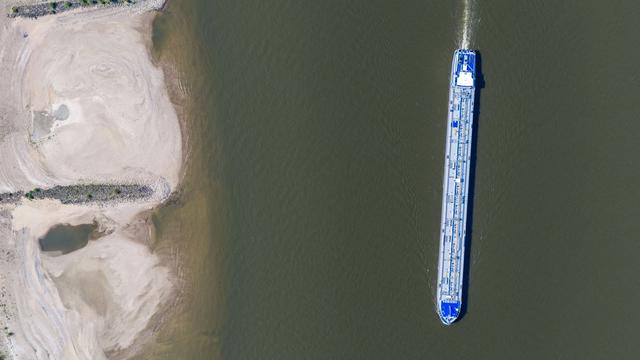
Low water levels in Germany's major rivers, including the Rhine, Elbe, and Danube, are posing significant economic challenges as new record lows are anticipated. The Federal Institute of Hydrology (BfG) reports widespread low water conditions, with rainfall offering only temporary relief. The overall trend indicates continuously falling water levels.
The overall trend indicates continuously falling water levels.
According to the Niwis information system, around 44% of measurement points on the Rhine are experiencing extremely low water levels, along with 16% on the Elbe and approximately 78% on the Danube. In Cologne, authorities expect a historic low of 67 centimeters on the Rhine this weekend, just two centimeters below the October 2018 record. Fabian Spieß, deputy managing director of the German Association of Inland Waterway Shipping (BDB), noted that water levels on the Rhine are critically low and have continued to fall.
The water levels on the Rhine are on a very low level and have fallen further in the last days.
While low water phases are not unusual, they typically occur later in the summer and autumn. Experts attribute the current situation to low rainfall and high temperatures, which increase evaporation. The BfG suggests that climate change is intensifying these low water events over the long term. Although there are no outright navigation bans, ship captains must decide when continuing to navigate becomes uneconomical. "Shipping operates as long as it is physically and safely possible," Spieß stated. However, reduced cargo capacity necessitates deploying more ships, and Moritz Axt from the Waterways and Shipping Office (WSA) Rhein confirmed that voyages become less profitable as water levels drop.
Shipping operates as long as it is physically and safely possible.
Thilo Schaefer from the Institute of the German Economy (IW) described the situation as serious, emphasizing the Rhine's role as a central artery for freight transport in Germany. The consequences include higher transport costs and increased pressure on road and rail networks, with limited capacity for diversion. This could lead to supply chain bottlenecks, particularly affecting industries such as chemicals, steel, and mineral oil, which depend heavily on large volumes of raw materials and intermediate products.
The situation is serious. The Rhine is a central artery for freight transport in Germany.
DistantNews Editorial
Originally published by Die Zeit in German. Translated, summarized, and contextualized by our editorial team with added local perspective. Read our editorial standards.
More Stories



From Our Blog

What Gets Lost (and Found) When News Is Translated

How the Same Story Looks Different in Different Countries

The Critical Role of Diaspora Media in Global News

What Travellers Should Know About Countries with Restricted Press

A Digital Nomad's Guide to Following Local News
