


 Image: ESPECIAL
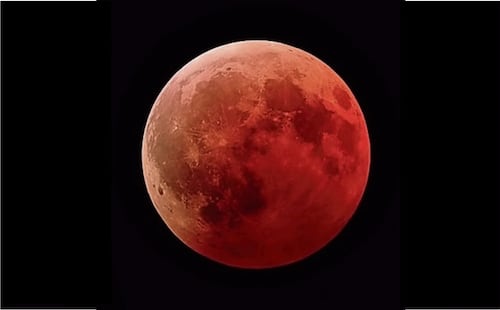
Lunar eclipse August 2026: What time is the peak of the 'Blood Moon' in Mexico?
Translated from Spanish and summarized by DistantNews. Read the original for the full story.
At a glance
News
Named sources
Context piece
- Mexico will observe a partial lunar eclipse on Thursday, August 27, 2026.
- The peak of the eclipse, known as the 'Blood Moon,' is expected around 10:12 PM Central Mexico time.
- The phenomenon will be visible across Mexico and parts of America, Europe, Africa, and Western Asia.
Mexico will have a front-row seat to a captivating astronomical event this Thursday, August 27, 2026, as a partial lunar eclipse graces the night sky. The celestial spectacle, often referred to as the 'Blood Moon,' will be visible from numerous locations across the country, provided the weather cooperates.
According to NASA, a partial lunar eclipse occurs when the Sun, Earth, and Moon are not perfectly aligned. In this scenario, a portion of the lunar surface enters Earth's umbra, the region where our planet directly blocks sunlight. Unlike a total eclipse, only a segment of the Moon will be enveloped by Earth's darkest shadow, while the remainder continues to receive illumination.
The astronomical show begins with the penumbral phase around 7:23 PM Central Mexico time. The partial phase commences at 8:33 PM, building towards the main event. The eclipse's maximum point, when the greatest obscuration occurs, is anticipated around 10:12 PM, though some sources suggest it could be as late as 10:14 PM. The partial phase concludes at 11:51 PM, with the penumbral phase ending in the early hours of Friday, August 28, at 1:01 AM.
Residents across Mexico, from Mexico City to Tijuana, will have the opportunity to witness this event. Beyond Mexico, the eclipse's visibility will extend across large swathes of the Americas, Europe, Africa, and Western Asia. No specialized equipment is necessary for viewing, making it an accessible event for all sky-gazers, contingent on clear atmospheric conditions.
About this summary
Originally published by El Universal in Spanish. Translated, summarized, and contextualized automatically by DistantNews, with a note on how the source frames the story. Not individually reviewed before publishing. How this works.
More Stories

From Our Blog

What Press Freedom Means for the News You Read

What Gets Lost (and Found) When News Is Translated

The Critical Role of Diaspora Media in Global News

What Travellers Should Know About Countries with Restricted Press

A Digital Nomad's Guide to Following Local News
