


Lynx 'Washes' Prey Before Eating - A Strange Behavior Never Before Seen in Carnivores
Translated from Vietnamese, summarized and contextualized by DistantNews.
TLDR
- Researchers have documented a rare behavior in Iberian lynx: a female lynx was observed washing a rabbit carcass in a water trough before eating it.
- This is the first time such a 'prey washing' behavior has been clearly recorded in a carnivorous mammal, challenging previous assumptions about their feeding habits.
- The exact reason for this behavior remains unknown, but hypotheses include aiding young lynx in transitioning to solid food or being a learned, socially transmitted behavior within a specific population.
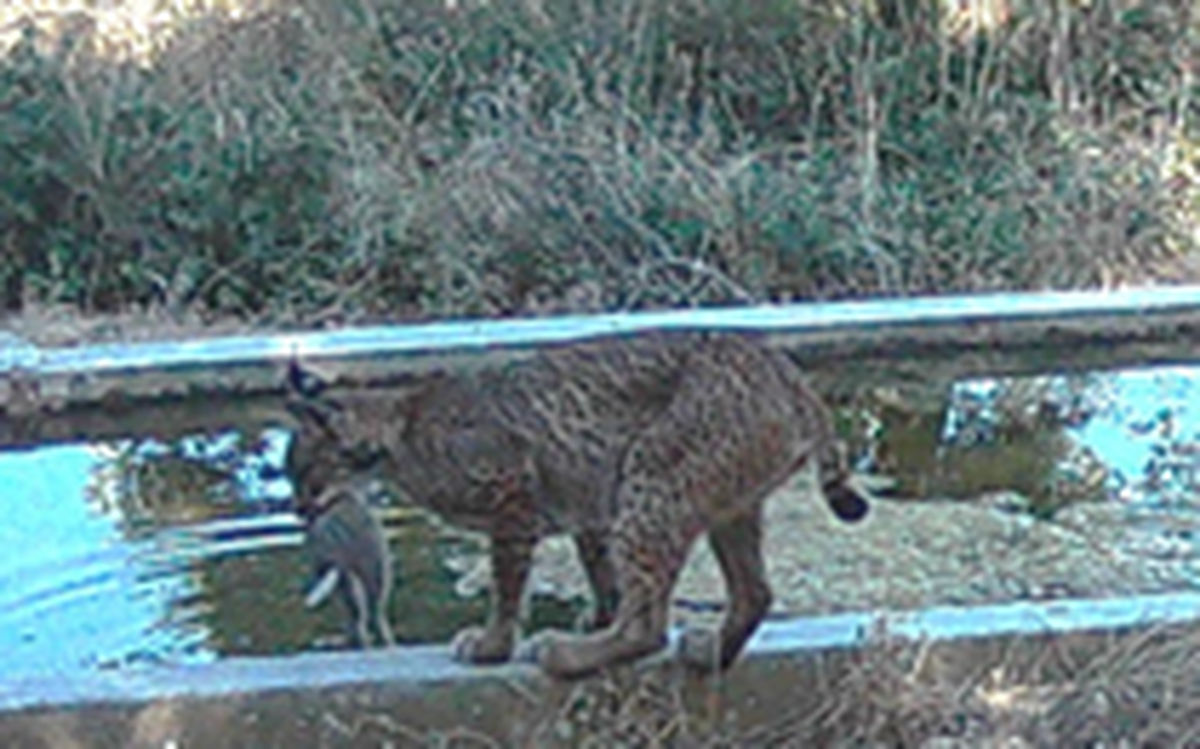
In a discovery that is reshaping our understanding of wild carnivore behavior, an international research team has captured unprecedented footage of an Iberian lynx engaging in a peculiar feeding ritual. The images, published in the journal Ecology, show a female lynx in Spain's Montes de Toledo region meticulously 'washing' a rabbit carcass in a water trough before consuming it. This marks the first time such a behavior has been definitively documented in a meat-eating mammal, prompting new questions about the cognitive abilities and adaptability of these elusive creatures.
This is the first time this behavior has been clearly recorded with images, although scientists have observed similar signs many times before but without direct evidence.
While other animals, such as pandas, primates, and certain birds, are known to 'wash' their food, these species are typically omnivores or herbivores. The observation of this behavior in a specialized carnivore like the Iberian lynx is particularly striking. Researchers recorded eight instances of this 'prey washing' across five different female lynx, noting that it was confined to a specific group and had not been observed in other lynx populations. This suggests it might be a learned behavior or a unique adaptation within this particular group.
Several hypotheses are being explored to explain this unusual practice. One possibility is that wetting the prey helps young lynx transition from a milk-based diet to solid food. Another theory posits that the behavior is learned and passed down through social interactions among related individuals. Factors like environmental temperature or water availability do not appear to be directly linked to this phenomenon, leaving its precise evolutionary or ecological purpose a mystery.
The fact that a carnivorous species like the Iberian lynx performs a similar behavior is completely surprising.
Regardless of the underlying cause, this finding underscores the complexity of animal behavior and the potential for social learning in species previously thought to be less capable of such intricate actions. It highlights how much we still have to learn about the natural world, even about species that have been subjects of study for a long time. The Iberian lynx, a symbol of conservation efforts, continues to reveal its secrets, reminding us of the rich, often surprising, tapestry of life on Earth.
The behavior of a predatory species exhibiting 'food processing' before eating may suggest social learning capabilities and more complex behavioral adaptations than previously recognized.
DistantNews Editorial
Originally published by Tuổi Trẻ in Vietnamese. Translated, summarized, and contextualized by our editorial team with added local perspective. Read our editorial standards.
More Stories


From Our Blog

What Gets Lost (and Found) When News Is Translated

The Critical Role of Diaspora Media in Global News

What Travellers Should Know About Countries with Restricted Press

A Digital Nomad's Guide to Following Local News

How the Same Story Looks Different in Different Countries
