


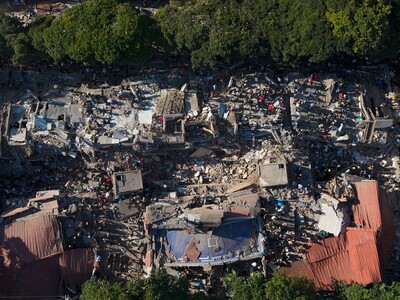
Magnitude 7.4 earthquake in Colombia causes damage and casualties
Translated from Spanish, summarized and contextualized by DistantNews.
At a glance
News
Sources not specified
Outcome reported
- A magnitude 7.4 earthquake struck Colombia, with its epicenter in the Chocó department at a depth of 103 kilometers.
- The quake, originating from a subduction mechanism involving the Nazca and South American plates, was felt across a wide area and caused at least 132 deaths.
- Experts differentiate this quake from recent ones in Venezuela, explaining that the Colombian event was a deeper subduction quake, while Venezuela's were shallower, lateral-strike quakes.
A powerful magnitude 7.4 earthquake, originating from a subduction mechanism, shook much of Colombia on Monday, causing widespread damage and claiming at least 132 lives. The epicenter was located in San José del Palmar, in the Chocó department, at a depth of 103 kilometers. This intermediate depth contributed to the seismic waves being felt across a vast swathe of the country.
It was a tectonic earthquake mainly associated with a subduction mechanism.
Viviana Dionisio, a seismologist with Colombia's National Seismological Network, explained that the earthquake was tectonically linked to the subduction process where the Nazca plate slides beneath the South American plate. This phenomenon, common in the Pacific Ring of Fire, involves the accumulation of energy that can trigger large-magnitude earthquakes. "When one tectonic plate is sliding under another, it is called a subduction earthquake. These generally occur on the coasts," Dionisio stated, drawing parallels to major earthquakes in Chile, Japan, and Ecuador.
When one tectonic plate is sliding under another, it is called a subduction earthquake. These generally occur on the coasts.
Dionisio also clarified that the recent earthquakes in Venezuela, which resulted in over 6,300 fatalities, stemmed from a different tectonic mechanism. While similar in magnitude, the Venezuelan quakes were a result of the interaction between the Caribbean and South American plates, characterized by lateral movement. "Venezuela's earthquakes are shallower and involve a different mechanism, a strike-slip mechanism. This is a deeper earthquake, a subduction earthquake," she emphasized.
Venezuela's earthquakes are shallower and involve a different mechanism, a strike-slip mechanism. This is a deeper earthquake, a subduction earthquake.
The depth of an earthquake plays a crucial role in its impact. While deeper quakes generally lose more energy as seismic waves travel through the Earth's crust, reaching the surface with less intensity, shallower quakes can deliver more powerful blows to nearby areas. However, Dionisio cautioned that depth is not the sole determinant of damage. The vulnerability of buildings and local ground conditions are also significant factors in the extent of destruction caused by seismic events. Colombia, situated at the confluence of several tectonic plates and crisscrossed by numerous faults, faces a significant seismic threat.
the depth does not solely determine the magnitude of the damage, as these also depend on the vulnerability of the buildings and the conditions of the ground.
DistantNews Editorial
Originally published by Diario Libre in Spanish. Translated, summarized, and contextualized by our editorial team with added local perspective. Read our editorial standards.
More Stories

From Our Blog

What Gets Lost (and Found) When News Is Translated

The Critical Role of Diaspora Media in Global News

What Travellers Should Know About Countries with Restricted Press

A Digital Nomad's Guide to Following Local News

How the Same Story Looks Different in Different Countries
