


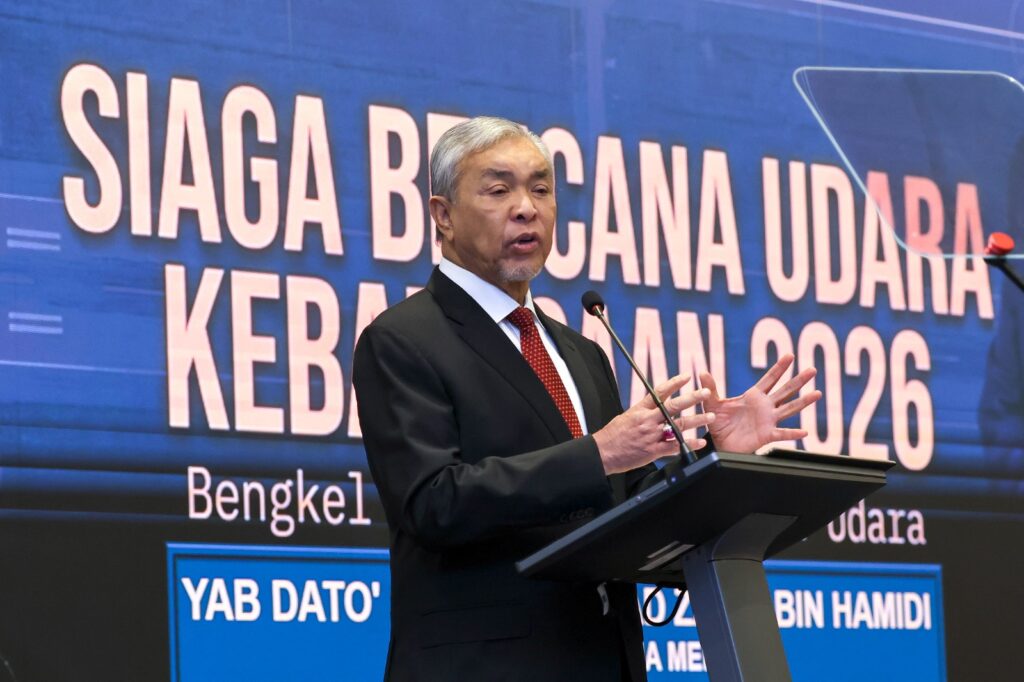
Malaysia Needs Integrated National Disaster Management System for Air Emergencies, Says Deputy PM
Translated from Malay, summarized and contextualized by DistantNews.
At a glance
News
Sources not specified
New plan
- Malaysia's Deputy Prime Minister urged the creation of an integrated national disaster management system for air-related emergencies.
- He stressed the need for unified command, communication, and action across all agencies to prevent delays during crises.
- The system must be functional under pressure, adaptable to rapid information changes, and capable of swift decision-making.
Malaysia needs to strengthen its national preparedness for air-related disasters by establishing an integrated management system that unifies all agencies under a single command, communication, and action framework. Deputy Prime Minister Datuk Seri Dr. Ahmad Zahid Hamidi emphasized that such a system is crucial to ensure coordinated and timely responses, preventing potentially fatal delays during emergencies.
"We cannot wait until a real crisis occurs to find out if our directives are clear, our communication is effective, and all agencies can move in sync," Ahmad Zahid stated at the National Air Disaster Preparedness 2026 workshop. He added that an effective system is not just one that exists on paper but one that functions under peak pressure, adapts to rapidly changing information, and enables decisions to be made within very short timeframes.
We cannot wait until a real crisis occurs to find out if our directives are clear, our communication is effective, and all agencies can move in sync.
Ahmad Zahid, who also chairs the National Disaster Management Committee, highlighted that true strength lies not in the quantity of assets or personnel, but in the ability to mobilize all resources, expertise, and authority towards a common goal. "Our principle must be clear: one system, one directive, and one action," he said, stressing the need for the national disaster team to unite all strengths under a purpose greater than individual organizational interests.
A good system is not a system that is only complete on paper; a good system is one that can function when pressure peaks, information changes rapidly, and decisions need to be made in a very short period.
The Deputy Prime Minister also linked aviation safety to national strategic interests, noting its role in connecting people, facilitating trade, attracting investment, and opening the country to the world. He cited that in 2025, 39 airports under Malaysia Airports handled 104.4 million passenger movements, with KLIA alone managing over 63.3 million. During peak festive seasons, over a million passengers were handled in just three consecutive days. "In such dense traffic, a minor disruption can become a major crisis if not handled immediately," he warned.
Furthermore, aviation safety is closely tied to economic strength. Malaysia welcomed 42.2 million international tourists last year, generating RM110.6 billion, while domestic tourism spending reached RM121.3 billion. Therefore, investments in disaster preparedness must be viewed as essential for protecting lives, maintaining global confidence in Malaysia, and ensuring all sectors contribute to national economic growth.
Our principle must be clear: one system, one directive, and one action because as a national disaster team, we must unite all strengths under a purpose greater than our respective organizational interests. This is the system we want to build.
DistantNews Editorial
Originally published by Utusan Malaysia in Malay. Translated, summarized, and contextualized by our editorial team with added local perspective. Read our editorial standards.
More Stories



From Our Blog

What Gets Lost (and Found) When News Is Translated

The Critical Role of Diaspora Media in Global News

What Travellers Should Know About Countries with Restricted Press

A Digital Nomad's Guide to Following Local News

How the Same Story Looks Different in Different Countries
