


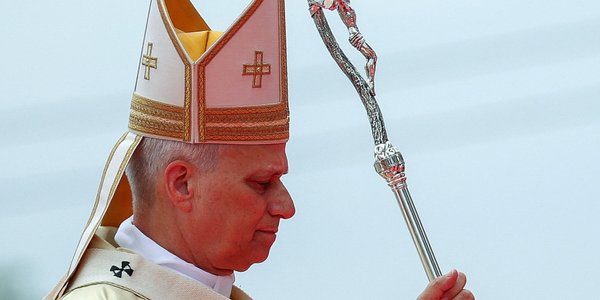
Marek A. Cichocki: Can the Pope Criticize the President?
Translated from Polish, summarized and contextualized by DistantNews.
TLDR
- US President Donald Trump publicly criticized Pope Francis, calling him
In an opinion piece for Rzeczpospolita, Marek A. Cichocki examines the recent public exchange between US President Donald Trump and Pope Francis, reframing it as a clash between fundamentally different political philosophies rather than a mere personal spat.
Pope Francis is WEAK on crime and terrible on foreign policy
Cichocki notes that Trump's criticism of the Pope's stance on crime and foreign policy, while characteristic of the US president, has caused consternation among Catholics. However, the author argues that this conflict, despite Trump being a Presbyterian and the Pope an American, transcends a simple intra-American dispute.
The core of Cichocki's argument lies in the perceived divergence between Trump's America and Pope Francis's vision. While Trump's approach emphasizes strength and power, potentially as a response to global adversaries like China, Russia, and Iran, the Pope, as the Vicar of Christ, cannot remain silent in the face of tyranny and the perpetuation of falsehoods. The author suggests that Trump's self-perception as a savior figure, coupled with his administration's policies, represents a departure from traditional Western values, potentially mirroring the very autocrats he opposes.
Francis is not doing a good job
From a Polish perspective, this commentary highlights a deep-seated concern about the erosion of Western civilization and the potential resurgence of authoritarianism. While Western media might focus on the personalities involved, Cichocki's analysis delves into the philosophical underpinnings of the conflict, suggesting that the Pope's role compels him to speak out against leaders who consolidate power through deception and violence. This resonates with a region historically wary of authoritarian regimes and deeply invested in the principles of democracy and human rights. The piece implicitly critiques a perceived weakness in Europe and contrasts it with a more assertive, albeit potentially problematic, American stance under Trump, urging a return to fundamental principles of justice and truth.
the Pope cannot remain silent in the face of the consolidation of earthly power of tyrants based on the lie of infallibility and the readiness for violence of omnipotence.
DistantNews Editorial
Originally published by Rzeczpospolita in Polish. Translated, summarized, and contextualized by our editorial team with added local perspective. Read our editorial standards.
More Stories

From Our Blog

What Gets Lost (and Found) When News Is Translated

The Critical Role of Diaspora Media in Global News

What Travellers Should Know About Countries with Restricted Press

A Digital Nomad's Guide to Following Local News

How the Same Story Looks Different in Different Countries
