


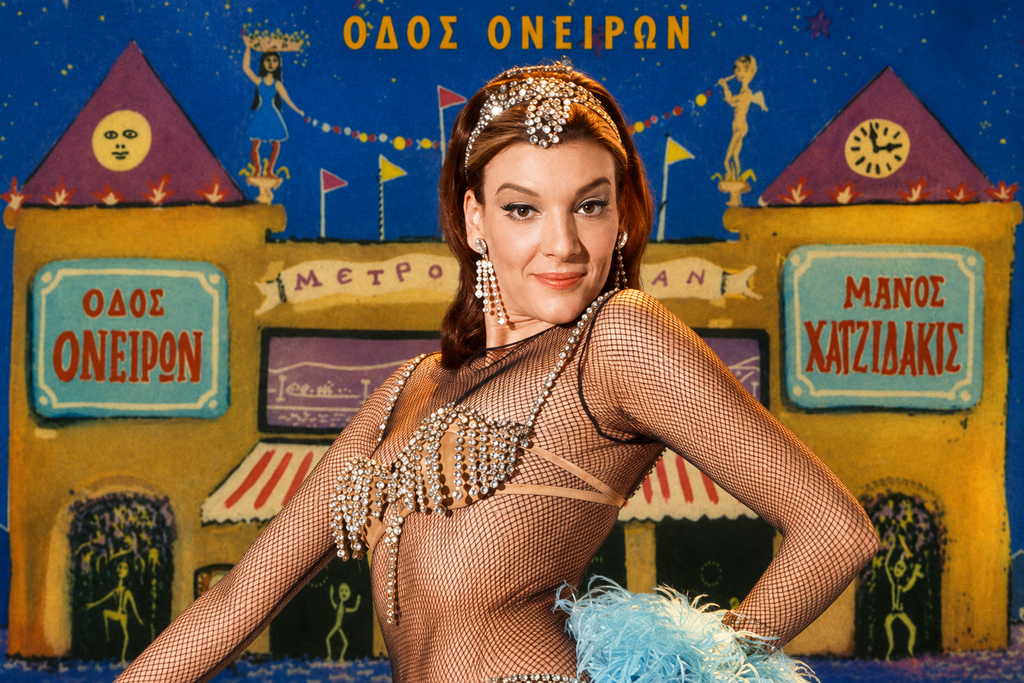
Maro Kontou: The Story Behind Her Collaboration with Manos Hadjidakis on "Odos Oneiron"
Translated from Greek, summarized and contextualized by DistantNews.
At a glance
In-depth
Sources not specified
Context piece
- The article mourns the passing of acclaimed Greek actress Maro Kontou at 92, highlighting her significant contributions to theater and cinema.
- It focuses on her memorable collaboration with composer Manos Hadjidakis on the iconic 1962 musical "Odos Oneiron" (Dream Street), where she performed key songs.
- Kontou's death marks the end of an era, as she was the last surviving artist from the original "Odos Oneiron" recording, leaving behind a rich artistic legacy.
The passing of Maro Kontou, a beloved figure in Greek arts, at the age of 92 has cast a shadow of grief across the nation. Kontou, celebrated for her elegance, aristocratic bearing, and dynamic presence, left an indelible mark on both the stage and the golden era of Greek cinema. Beyond her extensive acting repertoire, she was also recognized as a rare and sensitive vocalist, whose warm, theatrical tone and inner depth captivated composer Manos Hadjidakis.
Kontou's death signifies the silencing of the last living voice from the legendary "Odos Oneiron" (Dream Street) recording, a pivotal work that reshaped Greek music. The 1962 musical, staged at the Metropolitan summer theater with direction by Alexis Solomos, set design by Minos Argyrakis, and music by Hadjidakis, remains a landmark production.
Hadjidakis, recognizing Kontou's profound musicality and theatrical finesse, specifically chose her to interpret some of the work's most atmospheric pieces. On the album of the same name, her voice graced two emblematic songs: "Mavri Ford" (Black Ford), a piece imbued with theatricality, irony, and melancholy, which she delivered with a unique, aristocratic flair, and "Oi Adelphes Tata" (The Tata Sisters), a humorous yet deeply human song, performed alongside Zoi Fytousi, Niki Lemoni, and Soula Basta. With Kontou's passing, the circle of "Odos Oneiron" collaborators closes, leaving the recording to echo through eternity.
He never showed me how to sing. He gave me the piece, listened, smiled, and told me: “This is exactly what I want. Your own truth.”
In a poignant interview with Niki Lyberaki on the "Pame mia volta" podcast just months before her death, Kontou reflected on her life and career with her characteristic disarming honesty and inimitable style. She recalled her time working with Hadjidakis with reverence, stating, "He never showed me how to sing. He gave me the piece, listened, smiled, and told me: 'This is exactly what I want. Your own truth.'" This freedom allowed her to imbue the songs with her personal interpretation, a testament to Hadjidakis's trust in her artistic instincts.
Kontou also spoke movingly about the loneliness of outliving her friends and collaborators, a sentiment that now feels prophetic. "It's strange to look back and realize that the people who built this miracle are gone, and you are still here to tell the story," she shared. Her loss leaves Greek culture poorer, but her voice in "Mavri Ford" and the memories of "Odos Oneiron" will continue to evoke the beauty of a bygone era.
It's strange to look back and realize that the people who built this miracle are gone, and you are still here to tell the story.
DistantNews Editorial
Originally published by Ta Nea in Greek. Translated, summarized, and contextualized by our editorial team with added local perspective. Read our editorial standards.
More Stories

From Our Blog

What Gets Lost (and Found) When News Is Translated

The Critical Role of Diaspora Media in Global News

What Travellers Should Know About Countries with Restricted Press

A Digital Nomad's Guide to Following Local News

How the Same Story Looks Different in Different Countries
