


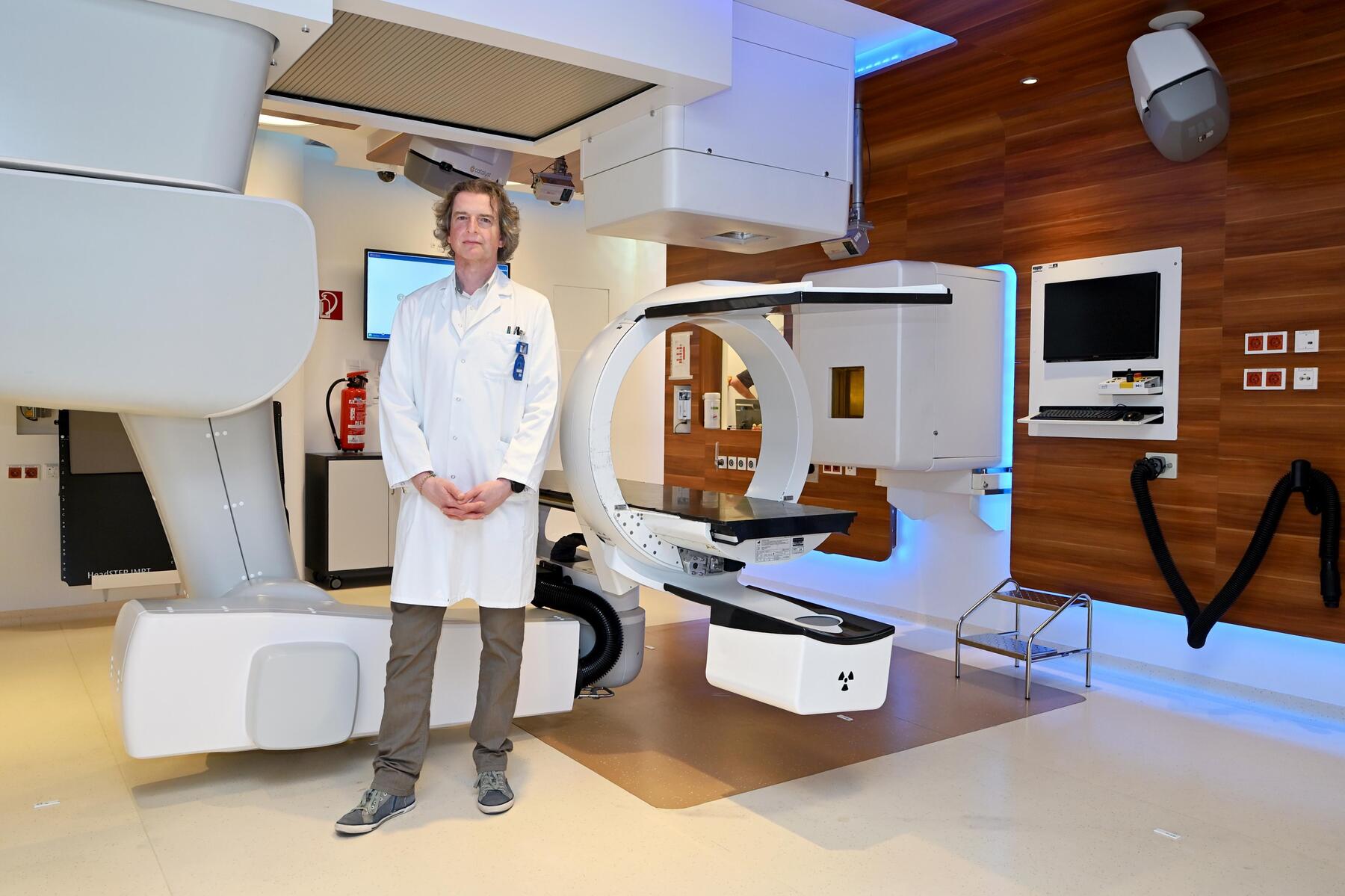
MedAustron: Ten Years of Research and Tumor Therapy at Austria's Particle Accelerator
Translated from German, summarized and contextualized by DistantNews.
At a glance
News
Named sources
Context piece
- MedAustron, Austria's only particle accelerator, combines scientific research with advanced cancer therapy, particularly for tumors near sensitive organs.
- The facility uses ion therapy, employing protons, carbon, and helium beams, to precisely target tumors while sparing surrounding healthy tissue.
- Researchers recently achieved a breakthrough by successfully mixing carbon and helium beams in the accelerator, a development they consider a "Christmas present" with potential for improved diagnostics and treatment positioning.
Nestled in the industrial area of Wiener Neustadt, Austria, lies MedAustron, a unique facility that serves a dual purpose: cutting-edge scientific research and advanced medical treatment. As Austria's sole particle accelerator, it opens its doors to the public for tours every two months when it pauses operations for essential maintenance and checks, allowing visitors, including students, to glimpse its inner workings. Unlike facilities solely dedicated to pure research, such as CERN, MedAustron focuses on applying its technology to medical treatments. It specializes in ion therapy, a highly precise form of radiation treatment that minimizes damage to healthy tissue surrounding a tumor. This method is particularly beneficial for tumors located near critical structures like the brain, spinal cord, eyes, or lungs, and is also crucial for treating children whose rapidly growing tissues are highly sensitive to radiation. The facility also treats patients for whom conventional radiation therapy has proven ineffective. At the heart of MedAustron are its ion sources, where charged particles are generated. Matthias Kausel, a doctoral student at the facility, explains that different gases like hydrogen, carbon dioxide, and helium are used to create proton, carbon, and helium beams, respectively. A significant recent achievement, described as a "Christmas present" by the team, was the successful mixing of carbon and helium beams within the ring accelerator on December 23, 2023. This innovation, not originally designed into the machine, could potentially lead to the development of a diagnostic beam to verify patient positioning during treatment and allow for real-time beam correction. Thomas Schreiner, head of non-clinical research, notes that the machine was not initially designed for such capabilities, highlighting the ongoing innovation at MedAustron. The facility continues to explore advancements, with aspirations for a fourth ion source, further expanding its potential in both research and therapeutic applications.
DistantNews Editorial
Originally published by Die Presse in German. Translated, summarized, and contextualized by our editorial team with added local perspective. Read our editorial standards.
More Stories

From Our Blog

What Gets Lost (and Found) When News Is Translated

The Critical Role of Diaspora Media in Global News

What Travellers Should Know About Countries with Restricted Press

A Digital Nomad's Guide to Following Local News

How the Same Story Looks Different in Different Countries
