


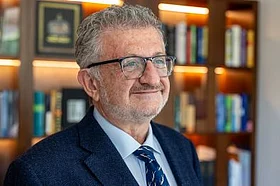
Meet the geneticist who spent 16 years helping build NYU Abu Dhabi from the ground up
Summarized by DistantNews. Read the original for the full story.
At a glance
In-depth
Sources not specified
Context piece
- Fabio Piano, a geneticist, reflects on his 16-year involvement in establishing NYU Abu Dhabi.
- The university's founding involved a significant meeting between NYU's president and Abu Dhabi's Crown Prince in 2006.
- NYU Abu Dhabi was conceived as a full residential research university, aiming to be "in and of the world."
Fabio Piano, a geneticist by trade, found himself deeply involved in the creation of NYU Abu Dhabi, an institution he helped build from a mere idea into a prominent academic center in the UAE over 16 years.
Don’t you like my tie?
His office serves as a testament to this journey, filled with mementos like an early campus sketch by architect Rafael Viñoly, books by NYUAD faculty, student work, and a unique glass sculpture made from sand from the seven emirates. Each item tells a story stretching back nearly two decades, long before students and a physical campus existed.
The university's genesis traces back to 2006, when NYU's then-president John Sexton met with Sheikh Mohamed bin Zayed Al Nahyan, then Crown Prince of Abu Dhabi. What began as a brief meeting evolved into a shared vision for a new kind of institution. By 2007, plans were announced for a full residential research university, with its first students arriving in 2010.
NYU, he said, would remain rooted in New York but also needed to become “in and of the world”.
Sexton's vision was for NYU to remain rooted in New York while becoming "in and of the world." Crucially, the university aimed not just to educate in Abu Dhabi but to be "educated and changed in turn" by its presence there. Piano, who had earned four degrees from NYU, was part of this transformative project from its early stages.
More importantly, he said the university was coming to Abu Dhabi not simply to educate, but with the expectation of being “educated and changed in turn”.
About this summary
Originally published by Khaleej Times. Summarized and contextualized automatically by DistantNews, with a note on how the source frames the story. Not individually reviewed before publishing. How this works.
More Stories



From Our Blog

What Gets Lost (and Found) When News Is Translated

The Critical Role of Diaspora Media in Global News

What Travellers Should Know About Countries with Restricted Press

A Digital Nomad's Guide to Following Local News

How the Same Story Looks Different in Different Countries
