


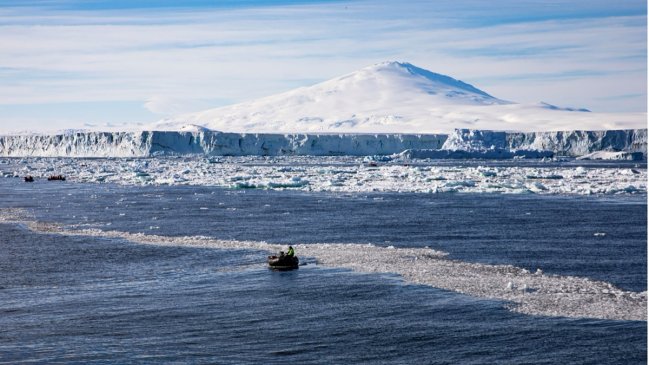
Melting ice turns Antarctica into a mercury pollution hotspot
Translated from Spanish, summarized and contextualized by DistantNews.
At a glance
News
Documents & data
Outcome reported
- Mercury accumulation in the Antarctic Peninsula has increased by 160% since the industrial era, a study found.
- Researchers attribute this rise to melting ice caused by climate change, which releases historically stored mercury.
- The study highlights the need to consider glacial melt as a key factor in managing global pollutants.
The Antarctic Peninsula has become a critical pollution hotspot for mercury, with accumulation rates soaring by 160% since the industrial era, according to a new study. Researchers attribute this alarming increase to the melting ice driven by global warming, which is releasing mercury historically sequestered in the land.
The study, published in the journal 'Proceedings' of the National Academy of Sciences, reconstructed mercury dynamics in the Antarctic Peninsula and its surrounding marine environment over the past 200 years. Using geochemical and isotopic records from 16 sediment cores, scientists found that the continental shelf around the peninsula is accumulating mercury at an increasing rate of approximately 93 micrograms per square meter annually, despite the region's remote location. This rate is nearly double the average mercury accumulation measured on other continental shelves.
With increasing temperatures and accelerated glacier retreat, this mercury that has been sequestered for so long is being released into the environment due to meltwater flow and surface erosion.
Researchers identified two primary mechanisms driving the mercury increase. The most significant is the melting and subsequent erosion of the peninsula due to rising global temperatures. Vast ice reserves have historically acted as massive reservoirs, trapping substantial amounts of atmospheric mercury deposited from both natural geological sources and industrial pollution. "With increasing temperatures and accelerated glacier retreat, this mercury that has been sequestered for so long is being released into the environment due to meltwater flow and surface erosion," the researchers explained.
The study indicates that the rate of mercury release linked to melting and erosion in Antarctica has grown by 550% since the industrial revolution. Additionally, as ice melts and releases mercury into the ocean, a significant portion is re-emitted into the atmosphere through air-sea gas exchange. Over the last two centuries, these mercury evaporation flows from the sea to the air have increased by 350%, driven by both ice melt and atmospheric deposition. The findings underscore "the need to consider ice melt as a key factor in the management of global pollutants," the authors concluded.
the need to consider ice melt as a key factor in the management of global pollutants.
DistantNews Editorial
Originally published by Cooperativa in Spanish. Translated, summarized, and contextualized by our editorial team with added local perspective. Read our editorial standards.
More Stories



From Our Blog

What Gets Lost (and Found) When News Is Translated

The Critical Role of Diaspora Media in Global News

What Travellers Should Know About Countries with Restricted Press

A Digital Nomad's Guide to Following Local News

How the Same Story Looks Different in Different Countries
