


Mesmerizing Jellyfish Take Center Stage at 1st US Museum Dedicated Solely to the Floating Predators
Summarized and contextualized by DistantNews.
At a glance
News
Named sources
Ongoing story
- An elephant named Genghis Khan died in southern Kenya from a mysterious ailment, exhibiting symptoms of partial paralysis.
- This affliction has killed at least 20 pachyderms since June, with Kenya Wildlife Service initially suggesting cyanide poisoning from nearby farms.
- Local Maasai community members and wildlife managers dispute the poisoning theory, believing it to be a disease specific to elephants, as other animals feeding on carcasses have not died.
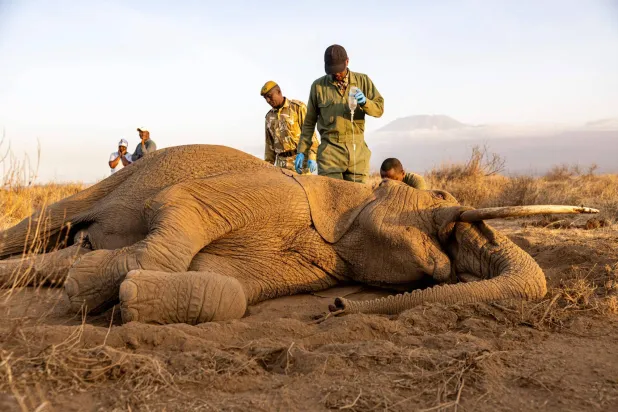
A mysterious ailment is claiming the lives of elephants in southern Kenya, leaving wildlife officials and local communities searching for answers. The latest victim, an 11-year-old male elephant named Genghis Khan, died Tuesday in Amboseli National Park, a region known for its elephant herds and tourism, overlooked by Mount Kilimanjaro.
You would find one struggling for a day, struggling for two or even three days. Until they completely die.
Genghis Khan exhibited symptoms of partial paralysis and struggled to breathe before succumbing. Vets administered a glucose injection, the only available treatment given the unknown cause. This case is part of a disturbing trend that has killed at least 20 elephants, predominantly females or young males, since June. All victims have shown identical symptoms, including partial paralysis.
It's a disease.
The Kenya Wildlife Service (KWS) initially suggested pesticide poisoning, citing high concentrations of cyanide found in carcasses in late July. However, this preliminary finding is met with skepticism by some local experts and community members. Patrick Papatiti, head of operations for Olgulului communal lands, dismisses the poisoning theory, stating, "It's a disease." He points out that scavengers and flies feeding on the carcasses have not died, which would be expected if the animals were poisoned.
If another animal feeds on that carcass and it is not dying, then definitely it is not a chemical.
Joel Nyika, Amboseli ecosystem manager for Kajiado County, supports the disease theory, noting that local livestock consuming similar foliage have not perished. While the KWS stated on August 7 that their findings do not indicate an infectious disease, rangers continue to observe carcasses with partial paralysis. Maasai farmers, like Noah Saatia, also reject the poisoning hypothesis, expressing their distress over the unexplained deaths of the elephants, which impact their livelihoods and the region's vital tourism industry.
As wildlife managers, we believe it could be a disease that is only affecting these elephants.
DistantNews Editorial
Originally published by Asharq Al-Awsat. Summarized and contextualized by our editorial team with added local perspective. Read our editorial standards.
More Stories


From Our Blog

What Gets Lost (and Found) When News Is Translated

The Critical Role of Diaspora Media in Global News

What Travellers Should Know About Countries with Restricted Press

A Digital Nomad's Guide to Following Local News

How the Same Story Looks Different in Different Countries
