


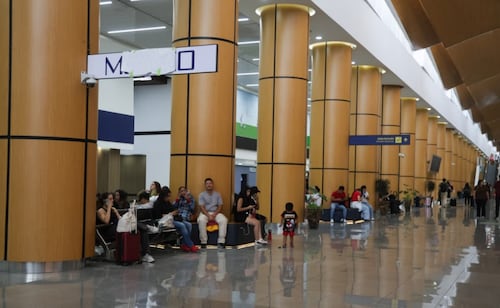
 Image: CARLOS MEJIA/EL UNIVERSAL
Mexico City airport launches earthquake drill program, says flights and passengers will not be affected
Translated from Spanish and summarized by DistantNews. Read the original for the full story.
At a glance
News
Official statement
Ongoing story
- Mexico City’s Benito Juárez International Airport began an earthquake drill program running from Aug. 28 to Sept. 19.
- The exercises will cover self-protection, evacuation, reunification, assessment and a return to normal operations across Terminals 1 and 2.
- The airport said the drills will not affect passengers or aircraft takeoffs and landings, and will culminate in the National Earthquake Drill on Sept. 19.
Mexico City’s Benito Juárez International Airport has started a series of earthquake drills designed to prepare everyone from airport employees to passengers for a major tremor, while keeping flights running normally.
The program began on Aug. 28 and will continue through Sept. 19 in offices and public areas at Terminals 1 and 2. The airport’s Civil Protection unit is coordinating the exercises, which it said will not disrupt travelers or aircraft arrivals and departures.
The drills will test several stages of an earthquake response, including self-protection, evacuation, assembly, assessment and the return to normal operations. The first exercise focused on explaining and reinforcing self-protection procedures. On Sept. 4 at 11 a.m., participants will practice a partial evacuation along a blocked route.
A tabletop exercise covering all response stages is scheduled for Sept. 14, followed by another earthquake drill on Sept. 16 at 11 a.m. The program will conclude on Sept. 19, when the airport joins Mexico’s National Earthquake Drill. That exercise will include hypothetical scenarios involving a fire and a person being struck, with participation from airport staff, airlines, service providers, security institutions, government agencies operating at the airport and passengers who choose to take part.
About this summary
Originally published by El Universal in Spanish. Translated, summarized, and contextualized automatically by DistantNews, with a note on how the source frames the story. Not individually reviewed before publishing. How this works.
More Stories

From Our Blog

What Press Freedom Means for the News You Read

What Gets Lost (and Found) When News Is Translated

The Critical Role of Diaspora Media in Global News

What Travellers Should Know About Countries with Restricted Press

A Digital Nomad's Guide to Following Local News
