


Mexico City Leader Calls for Judiciary Free of Political and Economic Interference
Translated from Spanish, summarized and contextualized by DistantNews.
At a glance
News
Sources not specified
New plan
- Mexico City's head of government, Clara Brugada, called for a judiciary free from political and economic influence.
- She emphasized the need for judicial discipline tribunals to protect judges from pressure.
- Brugada stated that justice should be accessible to all, regardless of wealth or status.
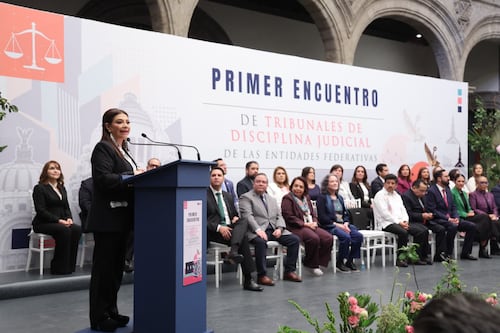
Mexico City's head of government, Clara Brugada, has called for a judicial system that operates independently of political and economic interests. Speaking at the First National Meeting of Judges of Judicial Discipline, Brugada stressed the "crucial mission" of judicial discipline tribunals to shield judges and magistrates from any form of pressure, whether economic, political, or criminal.
There should be no impunity behind independence, nor interference under the pretext of discipline.
"There should be no impunity behind independence, nor interference under the pretext of discipline," Brugada stated, highlighting the delicate balance required for the new institution. She emphasized that judges and magistrates, having emerged from citizen votes, carry a mandate to serve the nation and the Constitution through exemplary judicial practice. She envisions a justice system where wealth cannot dictate outcomes, political connections cannot sway rulings, and influence does not matter.
We need a justice where no economic interest can buy a resolution; where no political relationship can twist a sentence; where the surname or influence does not weigh; where the robe is not a symbol of privilege, but of moral authority.
Brugada also addressed the historical perception of justice as a lengthy and costly process for many. She declared that the "great challenge of this new era" is to open the doors of justice to everyone. "We need a justice where no economic interest can buy a resolution; where no political relationship can twist a sentence; where the surname or influence does not weigh; where the robe is not a symbol of privilege, but of moral authority," she asserted. She advocated for a system where the humble have the same rights as the wealthy, and where everyone stands equal before the law, irrespective of their social standing or financial status.
That the humble have exactly the same rights as those who hoard great fortunes. That before the law there are no weak or powerful. That before the law there are exclusively citizens, free and equal in dignity and rights.
DistantNews Editorial
Originally published by El Universal in Spanish. Translated, summarized, and contextualized by our editorial team with added local perspective. Read our editorial standards.
More Stories

From Our Blog

What Press Freedom Means for the News You Read

What Gets Lost (and Found) When News Is Translated

The Critical Role of Diaspora Media in Global News

What Travellers Should Know About Countries with Restricted Press

A Digital Nomad's Guide to Following Local News
