


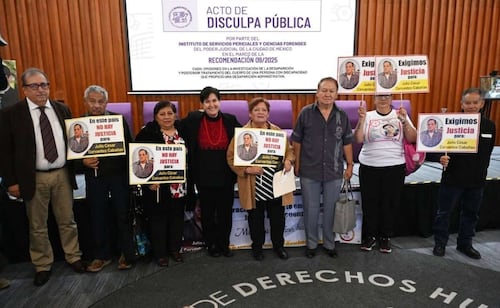
 Image: Especial.
Mexico Forensics Institute Apologizes for Releasing Body Without Family Consent
Translated from Spanish and summarized by DistantNews. Read the original for the full story.
At a glance
News
Sources not specified
Outcome reported
- Mexico City's Forensics Institute (INCIFO) has issued a public apology to the family of Julio César Cervantes Cabañas.
- The apology follows the INCIFO's decision to release Cervantes' body to the Polytechnic National Institute (IPN) medical school without the family's consent.
- The family's mother had searched for her son for three years before discovering his body's fate.
The Institute of Forensic Services and Criminal Investigation Sciences of Mexico City (INCIFO) has formally apologized to the family of Julio César Cervantes Cabañas for releasing his body to the Polytechnic National Institute (IPN) for medical studies without proper consent. This public apology is part of a recommendation issued by the Mexico City Human Rights Commission (CDHCM).
During the apology ceremony, Laura Cabañas, Julio César's mother, recounted her three-year search for her son across various states in Mexico. She expressed deep distress and confusion, questioning why authorities failed to identify her son and inform her of his whereabouts or the donation of his remains.
Why was no one able to identify my son? Why was no one able to inform me that my son had been located?
INCIFO Director Arturo Gerardo Cervantes Arroniz acknowledged the institution's failings, stating that the apology serves as an opportunity to recognize the harm caused, honor Julio's memory, and commit to preventing similar incidents. He admitted to deficiencies in identification processes and the utilization of available information to establish Julio César Cervantes Cabañas's identity promptly.
The CDHCM president noted that the incident violated Julio's right to be searched for and his family's right to truth, information, and the recovery and preservation of his memory. The case highlights critical issues in forensic identification and family notification protocols within the Mexican judicial and investigative systems.
We recognize that there were deficiencies in the processes of human identification, in the confrontation and use of available information to promptly establish the identity of Julio César Cervantes Cabañas.
About this summary
Originally published by El Universal in Spanish. Translated, summarized, and contextualized automatically by DistantNews, with a note on how the source frames the story. Not individually reviewed before publishing. How this works.
More Stories
From Our Blog

What Press Freedom Means for the News You Read

What Gets Lost (and Found) When News Is Translated

The Critical Role of Diaspora Media in Global News

What Travellers Should Know About Countries with Restricted Press

A Digital Nomad's Guide to Following Local News
