


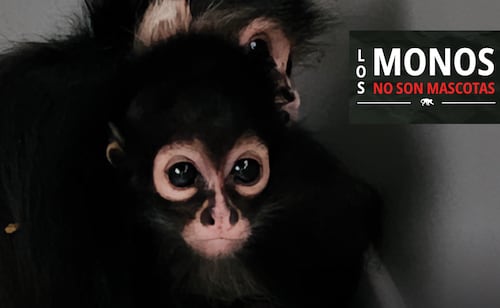
Mexico launches 'Monkeys Are Not Pets' campaign against primate trafficking
Translated from Spanish, summarized and contextualized by DistantNews.
At a glance
News
Named sources
New plan
- Mexico's environmental agency, Profepa, has launched a campaign called "Monkeys Are Not Pets" to combat the illegal trafficking of primates.
- The campaign aims to educate the public that extracting, trading, and possessing primates is illegal and harmful.
- Profepa has seized approximately 137 primates, including spider and howler monkeys, between 2019 and 2026.
Mexico's Federal Attorney for Environmental Protection (Profepa) has initiated a public awareness campaign titled "Monkeys Are Not Pets" to combat the illegal trafficking of primates within the country. The initiative seeks to educate citizens about the significant harm caused by the illicit trade and possession of primates, emphasizing that these animals are wild and belong in their natural habitats.
Monkeys Are Not Pets
Profepa stressed that extracting, trading, and possessing primates is prohibited by law and constitutes a criminal offense. The agency urged the public not to purchase, extract, or keep primates as pets, stating that the illegal wildlife trade is sustained by consumer demand. "If there is no demand, there is no consumption," Profepa declared in a statement, highlighting that each acquisition fuels a cycle of trafficking, mistreatment, and death.
The "Monkeys Are Not Pets" campaign features visual materials, including images and a video, illustrating the detrimental consequences of primate trafficking in Mexico. From 2019 to 2026, Profepa reported seizing around 137 primates. This includes 96 spider monkeys, 24 howler monkeys (Alouatta), and 17 black howler monkeys (Alouatta pigra). These species are listed as endangered under Mexico's NOM-059-SEMARNAT-2010 regulation and primarily inhabit the southeastern states of Chiapas, Tabasco, Campeche, Quintana Roo, and Oaxaca.
They are wild specimens and their natural habitat is where they are best found.
Profepa underscored that illegal primate trafficking inflicts immense suffering on the animals. According to Article 60 bis of the General Wildlife Law, commercializing any primate species can result in prison sentences ranging from one to nine years. The campaign also warns of the risks associated with keeping primates as pets, noting their potential difficulty to handle, their intolerance towards humans and other pets, and the serious risk of bites that can lead to infections and the transmission of diseases like herpes or hepatitis B. Primates are also susceptible to numerous infectious diseases.
If there is no demand, there is no consumption.
DistantNews Editorial
Originally published by El Universal in Spanish. Translated, summarized, and contextualized by our editorial team with added local perspective. Read our editorial standards.
More Stories



From Our Blog

What Press Freedom Means for the News You Read

What Gets Lost (and Found) When News Is Translated

The Critical Role of Diaspora Media in Global News

What Travellers Should Know About Countries with Restricted Press

A Digital Nomad's Guide to Following Local News
