


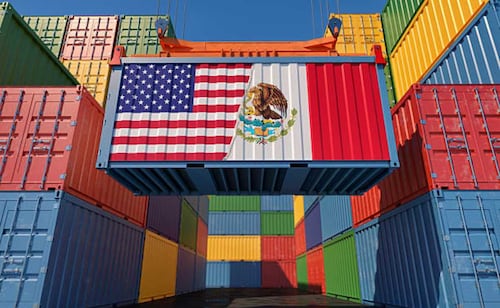
Mexico's exports favored by USMCA exemptions amid new U.S. tariffs, says BBVA
Translated from Spanish, summarized and contextualized by DistantNews.
At a glance
News
Named sources
Context piece
- BBVA Research reports Mexico maintains a favorable position against new U.S. tariffs due to T-MEC exemptions for qualifying exports.
- The U.S. announced a 10% tariff on imports from Mexico and 16 other economies, citing ineffective enforcement against goods produced with forced labor, though BBVA notes weak supporting evidence.
- The T-MEC's preferential access remains a key mechanism protecting Mexican exports, reinforcing incentives for regional content and compliance with origin rules.
Mexico's export sector remains in a relatively strong position despite new U.S. tariffs, primarily because goods meeting the USMCA (T-MEC) rules of origin will be exempt from the levy, according to BBVA Research. The U.S. Trade Representative's Office (USTR) announced a 10% tariff on imports from Mexico and 16 other nations, alleging ineffective enforcement against products made with forced labor. However, BBVA noted that the U.S. authority did not present robust evidence to support these claims.
BBVA highlighted that Mexican and Canadian products entering the U.S. under the USMCA framework will continue to be tariff-free. This exemption significantly limits the direct impact on national exports and preserves preferential access to the U.S. market. The financial institution pointed out that following a U.S. Supreme Court ruling limiting broad tariff imposition powers, the U.S. administration has utilized different sections of law to maintain its trade policy.
Despite these trade measures, Mexican exports to the U.S. have shown resilience, growing at an annualized rate of 7.7% as of May 2026. Mexico's share in U.S. imports reached a peak of 17.4%. The USTR acknowledged Mexico has a prohibition on importing goods produced with forced labor but deemed its enforcement lacking. Crucially, the resolution maintains exemptions for goods compliant with the USMCA.
BBVA views this differentiated treatment as reinforcing the USMCA's role in safeguarding Mexico's market access. It also maintains the incentive for increased regional content in exports and proof of compliance with origin rules. While this approach favors Mexico over competitors facing higher tariffs, BBVA cautioned that the measure increases international trade uncertainty and could lead to higher costs for consumers and businesses in the U.S.
DistantNews Editorial
Originally published by El Universal in Spanish. Translated, summarized, and contextualized by our editorial team with added local perspective. Read our editorial standards.
More Stories


From Our Blog

What Press Freedom Means for the News You Read

What Gets Lost (and Found) When News Is Translated

The Critical Role of Diaspora Media in Global News

What Travellers Should Know About Countries with Restricted Press

A Digital Nomad's Guide to Following Local News
