


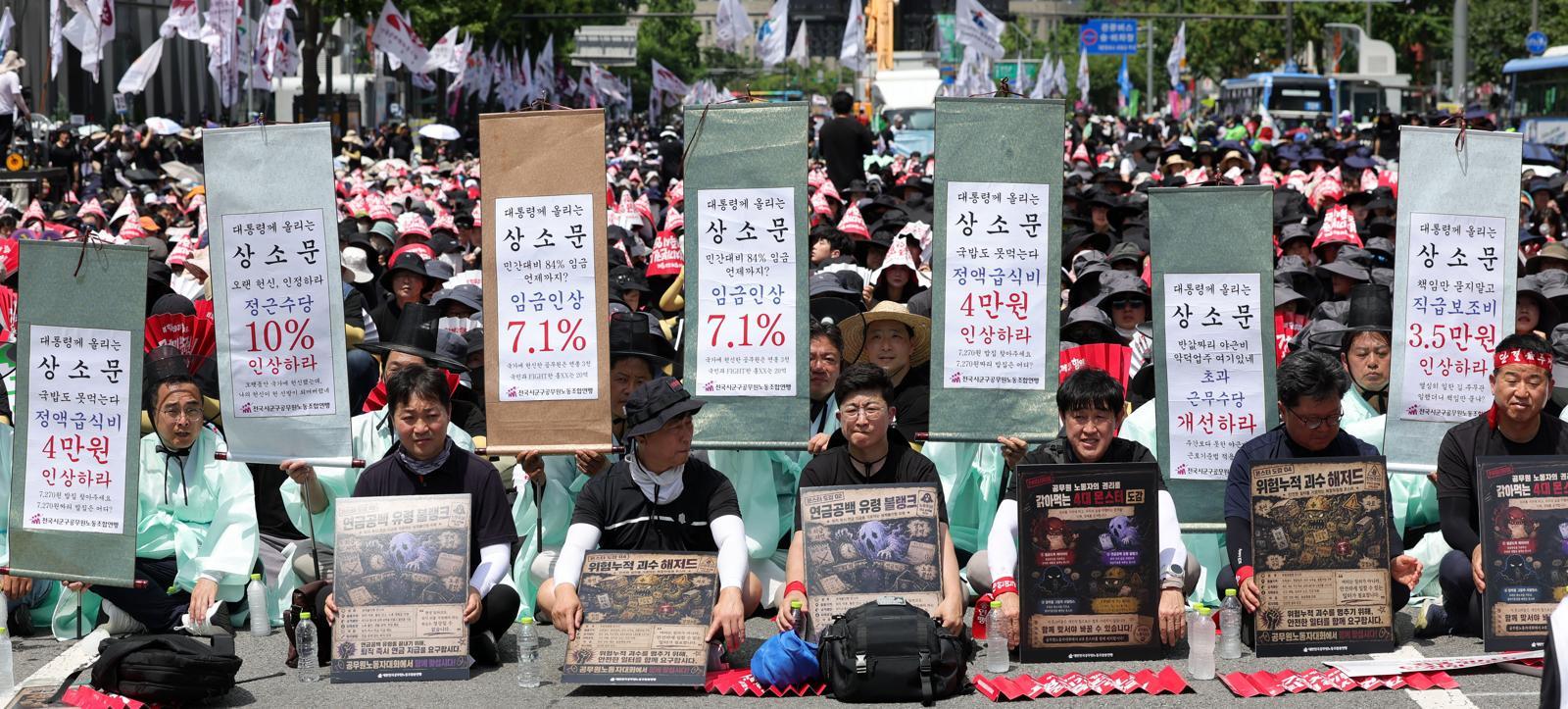
Minimum Wage Rises 3.7% Next Year, Public Servants Seek 7.1% Increase Amid Compensation Deliberations
Translated from Korean, summarized and contextualized by DistantNews.
At a glance
News
Sources not specified
Context piece
- South Korean public servants are seeking a 7.1% salary increase for 2027, citing economic growth and inflation.
- This demand comes as the minimum wage is set to rise by 3.7% to 10,700 won per hour.
- The Public Officials Compensation Committee is currently deliberating, with a decision expected soon, as public servants' base pay is close to the minimum wage.
Public servants in South Korea are pushing for a significant salary increase of 7.1% for 2027, a demand that has garnered considerable attention. This request is notably higher than the recently decided minimum wage hike of 3.7%, which will bring the hourly rate to 10,700 won. The Public Officials Compensation Committee is actively discussing the proposed increase, with a full committee meeting scheduled soon to finalize the decision.
The unions' demand for a 7.1% raise is based on projected economic growth (1.9%), inflation (2.0%), and an additional amount needed to bridge the gap with private sector salaries. They argue that the current compensation level for public officials, at 83.9% compared to private companies with over 100 employees as of last year, needs to be raised to 100% within five years. The unions are particularly concerned about the low starting salaries for entry-level positions, such as Grade 9 officials, whose basic monthly pay is currently less than the monthly equivalent of the minimum wage.
While the government's official proposal for the salary increase has not yet been presented, discussions are underway. The committee has held several subcommittee meetings, with the latest focusing on the basic direction of public official compensation adjustments. There is some optimism among the unions, as economic growth and inflation forecasts from the Ministry of Economy and Finance exceed those cited by the Bank of Korea and the Korea Development Institute, potentially leading to a more favorable government offer than initially anticipated.
The minimum wage increase is seen as a significant factor in the ongoing negotiations. Although not directly tied to public servant salaries, the minimum wage serves as a benchmark for overall wage levels. For lower-paid public servants, the minimum wage is a frequent point of comparison, influencing the perception of their compensation. The unions are advocating for a reasonable increase that reflects economic realities and addresses the perceived disparity with private sector wages, while also calling for improved conditions for mid-career officials who they feel have been overlooked.
We are of the position that salaries should increase at least by the economic growth rate and inflation rate. Therefore, we expect the government's proposal to be somewhat higher than this year.
DistantNews Editorial
Originally published by Dong-A Ilbo in Korean. Translated, summarized, and contextualized by our editorial team with added local perspective. Read our editorial standards.
More Stories
From Our Blog

What Gets Lost (and Found) When News Is Translated

The Critical Role of Diaspora Media in Global News

What Travellers Should Know About Countries with Restricted Press

A Digital Nomad's Guide to Following Local News

How the Same Story Looks Different in Different Countries
