


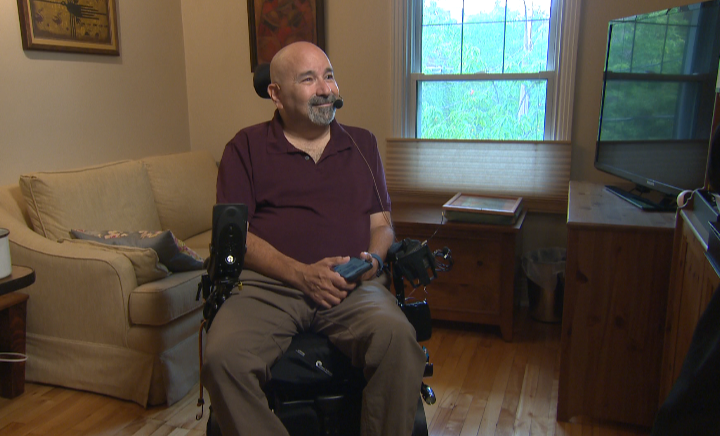
Montreal man with ALS shares story during awareness month, highlighting progress and hope
Translated from English, summarized and contextualized by DistantNews.
At a glance
In-depth
Named sources
Context piece
- Normand MacIsaac, living with ALS for over a decade in Montreal, shares his story during ALS Awareness Month.
- He emphasizes maintaining a positive mindset, gratitude, and strong family support to cope with the incurable disease.
- Researchers note significant progress in ALS treatment, partly fueled by the Ice Bucket Challenge, offering hope for future therapies.
During ALS Awareness Month in Canada, Normand MacIsaac, a Montreal resident diagnosed with amyotrophic lateral sclerosis over a decade ago, is sharing his experience to offer hope to others facing the incurable neurodegenerative disease.
For me it’s important to share openly.
MacIsaac, who refuses to let ALS define him, describes himself as "the luckiest of the unlucky." He credits a positive mindset, strong family support, and a focus on gratitude for helping him navigate the progressive illness. "For me it’s important to share openly," he said. After his 2014 diagnosis at age 51, MacIsaac chose to become an advocate rather than hide from the topic. "Not avoid the topic, not hide behind false optimism, to accept. But then to focus on the positives without denying the negative," he explained.
Adjusting to depending on others for support has been one of the most challenging changes for MacIsaac, who previously worked with marginalized communities globally. He notes that technology aids communication but limits spontaneous participation in discussions. "When I try to use my voice, I am frequently misunderstood, and when I use my cloned voice it takes time to type everything down," he added. The disease necessitates significant psychological and social adjustments, including reordering daily priorities.
Not avoid the topic, not hide behind false optimism, to accept. But then to focus on the positives without denying the negative.
His wife, Christine, who has been his primary caregiver, also shared how the role has brought substantial changes to her life. ALS affects nerve cells controlling voluntary muscle movement, progressively impairing patients' ability to walk, speak, and breathe. While a cure remains elusive, researchers report significant advances in recent years.
Technology makes a huge difference, but I can’t just spontaneously participate in discussions. When I try to use my voice, I am frequently misunderstood, and when I use my cloned voice it takes time to type everything down.
Dr. Angela Genre, director of McGill Clinical Research, highlighted that much of the current progress is linked to funding from the viral Ice Bucket Challenge campaign. "Biomark development, our identification of new targets, our identification of drugs that target the disease. All of that was tremendously aided by the Ice Bucket Target," Genre stated. The 2014 campaign raised over $17.2 million from more than 260,000 Canadian donors, with a significant portion invested in research. "With some of the results we have right now, we are seeing a fast-forward toward being able to treat everybody, so I am very hopeful," she said, emphasizing that early identification is crucial for treatment advancements.
Biomark development, our identification of new targets, our identification of drugs that target the disease. All of that was tremendously aided by the Ice Bucket Target.
DistantNews Editorial
Originally published by Global News in English. Translated, summarized, and contextualized by our editorial team with added local perspective. Read our editorial standards.
More Stories


From Our Blog

What Gets Lost (and Found) When News Is Translated

The Critical Role of Diaspora Media in Global News

What Travellers Should Know About Countries with Restricted Press

A Digital Nomad's Guide to Following Local News

How the Same Story Looks Different in Different Countries
