

Morocco Detains Dozens of Migrants Attempting to Enter Ceuta; Spanish Media Expelled
Translated from English, summarized and contextualized by DistantNews.
At a glance
News
Sources not specified
Ongoing story
- Moroccan police detained dozens of migrants attempting to cross into the Spanish exclave of Ceuta.
- The operation is described as routine, aimed at preventing irregular migration following a large surge two weeks prior.
- Spanish media representatives were ordered to leave Fnideq, raising concerns about press freedom.
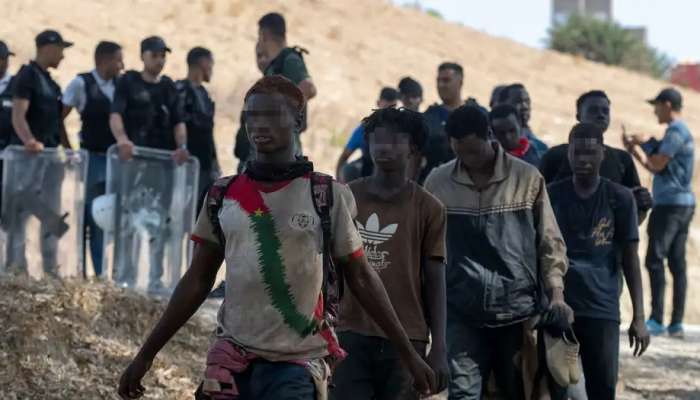
Moroccan police detained dozens of individuals attempting to cross the border into Ceuta, the Spanish North African exclave, on Saturday. This action follows a significant surge of approximately 72,000 migrants into Ceuta two weeks ago, an event that strained relations between Spain and other European Union countries.
An official familiar with the operation, who requested anonymity, described it as a "routine operation aimed at preventing attempted irregular migration" toward Ceuta. A security source told Reuters that over 100 migrants, primarily from sub-Saharan Africa, were stopped in or near Fnideq, the Moroccan city opposite Ceuta. Morocco's Le360 media outlet reported a higher figure, stating that 294 people were detained.
This is a routine operation aimed at preventing attempted irregular migration toward Ceuta.
Earlier this week, Rabat indicated it was monitoring "social media posts and messages of unknown origin" that called for a mass crossing on August 15. The authorities warned that organizers and participants would face prosecution. Eyewitnesses reported a heavy Moroccan security presence around Ceuta and the nearby Spanish exclave of Melilla, with numerous checkpoints, coastal patrols, and water cannons stationed at the border, according to Spain's public broadcaster RTVE.
We'll continue to deploy whatever personnel are necessary to restore normality as soon as possible and prevent events like those of July 30 from happening again.
In a related development, Spanish media outlets EFE and RTVE reported that a representative from Morocco's Interior Ministry ordered their journalists to leave Fnideq immediately without explanation. The Moroccan official stated he was "following instructions." EFE president Miguel Angel Oliver urged Moroccan authorities to respect the "free, responsible and rigorous practice of journalism." RTVE president Jose Pablo Lopez demanded "full guarantees and the utmost respect" for his journalists to "freely practice their profession anywhere in the border region," calling the expulsion "a grave obstacle to press freedom and the right to information."
Madrid has since increased security in Ceuta, installing a maritime barrier and deploying over 500 additional police officers. The Interior Ministry stated these measures would remain in place as long as necessary to restore normality and prevent a recurrence of the July 30th events, during which approximately 100 people died during the border surge.
The expulsion of our professionals from Castillejos represents a grave obstacle to press freedom and the right to information.
DistantNews Editorial
Originally published by Times of Oman in English. Translated, summarized, and contextualized by our editorial team with added local perspective. Read our editorial standards.
More Stories

From Our Blog

What Gets Lost (and Found) When News Is Translated

The Critical Role of Diaspora Media in Global News

What Travellers Should Know About Countries with Restricted Press

A Digital Nomad's Guide to Following Local News

How the Same Story Looks Different in Different Countries
