


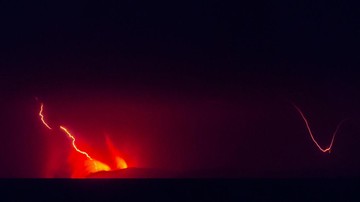

Mount Ili Lewotolok Erupts in Indonesia’s East Nusa Tenggara
Translated from Indonesian and summarized by DistantNews. Read the original for the full story.
At a glance
News
Official statement
Ongoing story
- Mount Ili Lewotolok in Lembata regency, East Nusa Tenggara, erupted at 6:11 a.m. local time on Sept. 6, sending an ash column about 400 meters above the summit.
- Indonesia’s Geological Agency said the gray ash column moved west, while the eruption lasted 40 seconds and recorded a maximum seismic amplitude of 40 millimeters.
- Authorities urged residents and visitors to avoid areas within 2 kilometers of the crater and warned of possible lava falls, landslides and hot clouds.
Mount Ili Lewotolok erupted Sunday morning, sending a gray column of ash 400 meters above its summit in Lembata, East Nusa Tenggara.
Indonesia’s Geological Agency recorded the eruption at 6:11 a.m. local time on Sept. 6. The ash column moved west with thick intensity. Seismographs recorded a maximum amplitude of 40 millimeters, and the eruption lasted 40 seconds.
The volcano has erupted repeatedly. On Tuesday morning, Sept. 1, it produced two eruptions, according to the report.
An eruption of Mount Ili Lewotolok occurred on Sunday, Sept. 6, 2026, at 6:11 a.m. local time. The observed eruption column reached approximately 400 meters above the summit, or approximately 1,823 meters above sea level.
The Geological Agency urged residents, hikers and tourists not to enter or conduct activities within a 2-kilometer radius of the volcano’s activity center. It also set a restricted area extending 3 kilometers to the south and southeast.
Authorities warned of possible falling or sliding lava and hot clouds in the southern and southeastern sectors, as well as the western and northeastern sectors. Residents were advised to wear masks and protect their eyes and skin, cover clean-water containers, and coordinate with the Ili Lewotolok observation post or Indonesia’s Geological Agency for updates.
Residents around Mount Ili Lewotolok, as well as visitors, hikers and tourists, should not enter or conduct activities within a 2-kilometer radius and within the 3-kilometer southern and southeastern sectors from the volcano’s activity center.
About this summary
Originally published by CNN Indonesia in Indonesian. Translated, summarized, and contextualized automatically by DistantNews, with a note on how the source frames the story. Not individually reviewed before publishing. How this works.
More Stories

From Our Blog

News in Translation: What Gets Lost, and How We Keep the Framing

Diaspora Media: How Communities Follow News From Home

Traveling Where the Press Is Not Free: How to Read the News There

The Digital Nomad's Guide to Local News

The Same Story, Different Countries: How Coverage Changes at the Border
