


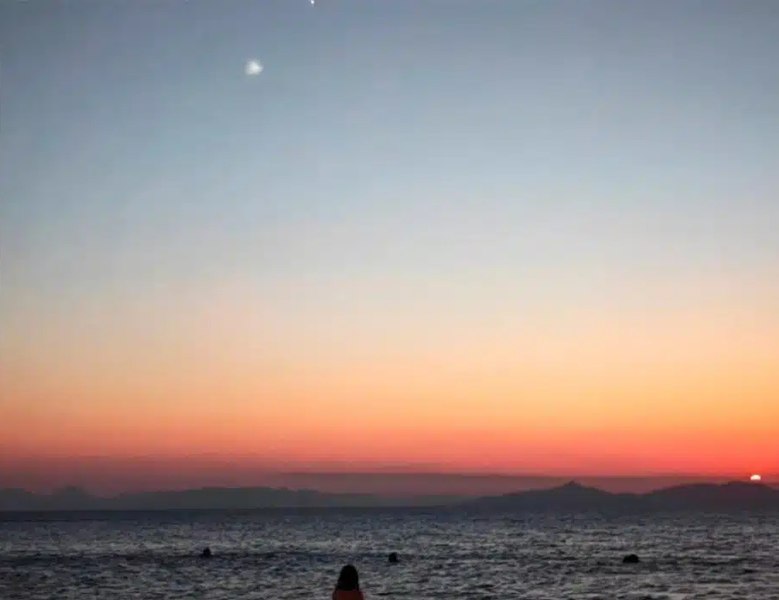
Mysterious Luminous Cloud Over Greece Sparks UFO Speculation; Meteorologists Explain Rocket Trail
Translated from Romanian, summarized and contextualized by DistantNews.
At a glance
News
Sources not specified
New plan
- A luminous cloud appeared in Greece, sparking speculation about UFOs among tourists and locals.
- Meteorologists explained the phenomenon as a trail left by a rocket in the upper atmosphere.
- The bright appearance was due to the high altitude, allowing the trail to be illuminated by the sun even after sunset.
A striking luminous cloud formation appeared in the skies over Greece, capturing the attention of tourists and locals alike and quickly fueling speculation about UFOs. The unusual sight, observed in various parts of the country including the Saronida beach in Attica and on the island of Crete, occurred against a nearly clear sky, making the solitary formation appear even more mysterious.
Social media buzzed with reactions, with some users suggesting extraterrestrial visitors while others hypothesized about rare atmospheric events or even military tests. The striking visuals, showing a bright, almost ethereal shape against the darkening sky, prompted widespread curiosity and discussion.
However, meteorologists offered a scientific explanation for the spectacular display. Thodoris Kolydas, former director of Greece's National Meteorological Service, clarified that the "luminous cloud" was not a naturally formed cloud but rather a persistent trail left by a rocket in the upper atmosphere. He explained that at extreme altitudes, where the air is exceptionally thin, gases and fuel expelled by a rocket's upper stage do not dissipate like typical exhaust fumes.
Instead, these substances expand rapidly over vast distances. As the rocket maneuvers or rotates, the expelled material can form dramatic shapes, including near-geometric spirals or glowing halos. Such phenomena can be caused by rocket launches, including those using Falcon 9 rockets by SpaceX, which carry satellites into orbit.
The phenomenon's brightness, especially noticeable against the twilight, is attributed to its high altitude. Even as the sun set at ground level, the formation, hundreds of kilometers above Earth, could still be directly illuminated by sunlight. Particles and gases from the launch reflected this solar light back towards the surface, creating the illusion of a glowing cloud in the dark sky. This effect, known as a "crepuscular effect," can transform upper atmospheric gases and particles into spectacular luminous streaks, sometimes displaying a range of colors from white and blue to rainbow-like hues.
In the extreme upper atmosphere, the air is extraordinarily rarefied. When the upper stage of a rocket evacuates excess gases or fuel, they do not behave like ordinary exhaust gases at ground level. Instead, they expand rapidly over very large distances.
DistantNews Editorial
Originally published by Adevărul in Romanian. Translated, summarized, and contextualized by our editorial team with added local perspective. Read our editorial standards.
More Stories



From Our Blog

What Gets Lost (and Found) When News Is Translated

The Critical Role of Diaspora Media in Global News

What Travellers Should Know About Countries with Restricted Press

A Digital Nomad's Guide to Following Local News

How the Same Story Looks Different in Different Countries
