


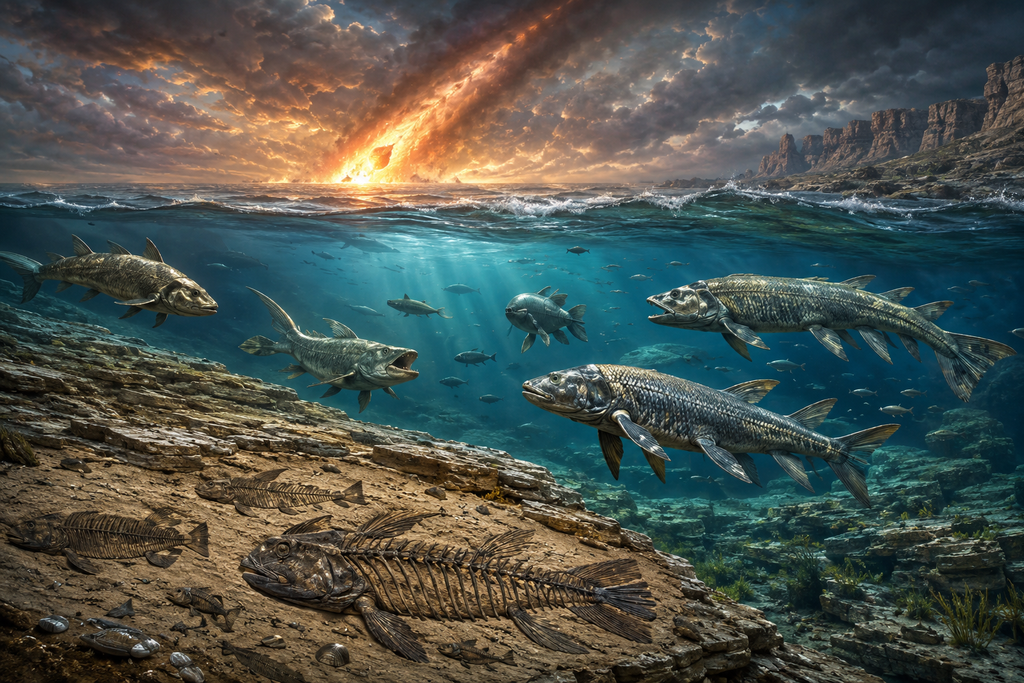
Mystery of Fish Survival After Asteroid Impact Solved by Egyptian Fossil Discovery
Translated from Greek, summarized and contextualized by DistantNews.
At a glance
News
Sources not specified
Context piece
- Scientists have discovered a rare fossil deposit in Egypt's Eastern Desert, dating back 62.2 million years, which helps solve the mystery of fish survival after the dinosaur-killing asteroid impact.
- The 'Qreiya 3' site preserved hundreds of fish skeletons from a low-oxygen ancient seabed, revealing over 20 species, including ancestors of modern fish and early relatives of seahorses.
- The findings indicate that modern fish groups, particularly perciforms, rapidly dominated marine ecosystems just four million years after the asteroid impact, filling ecological niches left by extinct marine predators.
A significant paleontological discovery in Egypt's Eastern Desert is shedding light on a long-standing evolutionary mystery: what happened to fish after the asteroid impact 66 million years ago that wiped out the dinosaurs.
The Paterson Gap.
For decades, scientists noted a substantial gap in the fossil record for fish during the first ten million years following the cataclysm, a period dubbed the "Paterson Gap." Now, an international research team has unearthed an exceptionally rare fossil site, 'Qreiya 3,' dating to 62.2 million years ago. This ancient deep-sea bed, characterized by extremely low oxygen levels, prevented decomposition, preserving hundreds of fish skeletons in remarkable condition.
The site has yielded fossils of over 20 distinct fish species, many bearing striking resemblances to modern marine life. Among the discoveries are the earliest known relatives of seahorses and ancestors of commercially important fish like tuna, mackerel, and jackfish. This trove of evidence offers an unprecedented glimpse into marine ecosystems during the recovery period after the mass extinction event.
The Qreiya 3 deposit functioned like a real time capsule.
Perhaps the most striking conclusion from the research is the rapid dominance of perciforms, the group encompassing most modern bony fish, in marine ecosystems. These fish had already taken over just four million years after the asteroid strike. This suggests that the extinction of large Cretaceous marine predators created significant ecological vacuums that were quickly exploited by the ancestors of today's fish, mirroring how mammals rose to prominence on land after the dinosaurs' demise.
The most impressive conclusion of the research is that the so-called perciforms, the group to which the majority of modern bony fish belong, had already dominated marine ecosystems just four million years after the asteroid impact.
This discovery also underscores the importance of exploring under-represented regions in scientific research. The team highlights that an over-reliance on fossils from Europe and North America had left vast areas like North Africa largely unexplored, potentially holding crucial answers to Earth's life history. The Egyptian site, described as a "small ray of light," offers a vital piece of the puzzle in understanding the resilience and rapid diversification of marine life.
The Egyptian deposit is only 'a small ray of light in a until now dark period of the history of life.'
DistantNews Editorial
Originally published by Ta Nea in Greek. Translated, summarized, and contextualized by our editorial team with added local perspective. Read our editorial standards.
More Stories



From Our Blog

What Gets Lost (and Found) When News Is Translated

The Critical Role of Diaspora Media in Global News

What Travellers Should Know About Countries with Restricted Press

A Digital Nomad's Guide to Following Local News

How the Same Story Looks Different in Different Countries
