


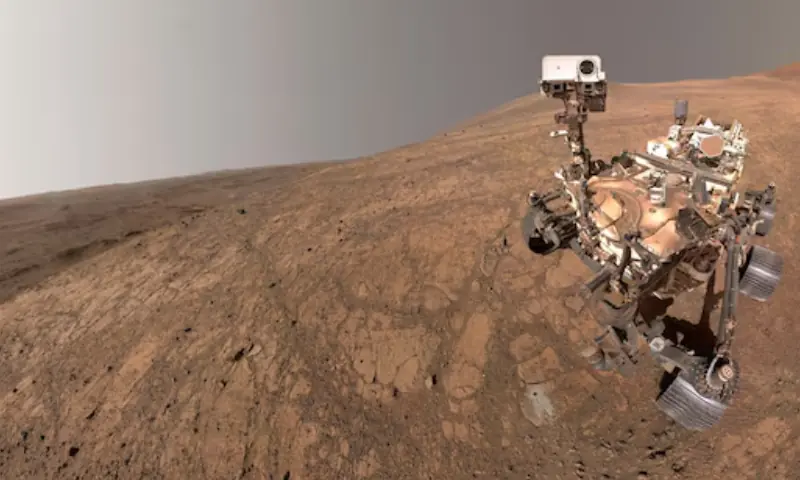
NASA Rover Examines Organic Carbon on Mars for Signs of Past Life
Translated from English, summarized and contextualized by DistantNews.
At a glance
News
Sources not specified
Context piece
- NASA's Perseverance rover is examining organic carbon found on Mars to assess the possibility of past life.
- New research details the structure of organic carbon detected in sedimentary rock within Jezero Crater, potentially indicating microbial life.
- The presence of organic carbon is a clue for past life but can also arise from nonbiological processes.
NASA's Perseverance rover is providing scientists with a closer look at organic carbon on Mars, a key element in the search for evidence of past life. The rover has detected organic carbon in sedimentary rock within Jezero Crater, an area believed to have once held water. This discovery is crucial for understanding whether Mars ever harbored life.
Recent research published in the journal Science Advances focuses on the structure of this organic carbon, found in mudstone that formed between 3.2 and 3.8 billion years ago. The rock contains features that could be a potential biosignature, a sign of past microbial life. Organic carbon serves as the chemical foundation for molecules essential to life, such as DNA, cells, and proteins.
However, the presence of organic carbon alone is not definitive proof of life, as it can also be produced through nonbiological chemical reactions between rock and water. Perseverance previously detected organic carbon in two rocks, named Cheyava Falls and Walhalla Glades, located about 100 meters apart. These findings strengthen the possibility that Mars was habitable and possessed organic materials billions of years ago.
Using the rover's SHERLOC instrument, researchers analyzed the complex macromolecular carbon in these rocks. They found similarities to carbon formed through both biological and non-biological processes on Earth, as well as abiotic carbon found in meteorites. This marks the first time macromolecular carbon has been discovered in the mudstones of Jezero Crater, where Perseverance landed in 2021. NASA's Curiosity rover had previously found similar carbon at a different Martian site, Gale Crater.
These findings indicate that the habitability of Mars and the availability of organic materials may have been widespread across the planet billions of years ago. This strengthens evidence that ancient Mars had chemical ingredients
DistantNews Editorial
Originally published by Dawn in English. Translated, summarized, and contextualized by our editorial team with added local perspective. Read our editorial standards.
More Stories



From Our Blog

What Gets Lost (and Found) When News Is Translated

The Critical Role of Diaspora Media in Global News

What Travellers Should Know About Countries with Restricted Press

A Digital Nomad's Guide to Following Local News

How the Same Story Looks Different in Different Countries
