


Nepal floods expose gaps in warning systems and China data sharing
Translated from English and summarized by DistantNews. Read the original for the full story.
At a glance
News
Named sources
Ongoing story
- Nepal’s catastrophic floods gave many victims less than five minutes’ warning, according to Dharam Raj Uprety, chief executive of the National Disaster Risk Reduction and Management Authority.
- The disaster exposed limited weather monitoring and cross-border data sharing in the high Himalayas, where warming may be destabilising glaciers and slopes.
- At least 800 people died and more than 3,000 remain missing, while damage could reach US$5 billion and reconstruction may take years.
Many victims of Nepal’s catastrophic floods had less than five minutes to escape, exposing a dangerous gap in the country’s ability to monitor the high Himalayas and share data with neighbouring China.
“People even didn’t get five minutes of lead time,” Dharam Raj Uprety, chief executive of Nepal’s National Disaster Risk Reduction and Management Authority, told Bloomberg News. Nepal has few weather stations in its highest mountain areas because of the cost and difficulty of installing and maintaining them.
People even didn’t get five minutes of lead time.
Uprety identified the lack of “trans-boundary data seeding mechanisms”, or systems for sharing weather and climate information across borders, as one of the country’s biggest challenges. While monitoring infrastructure exists farther downstream, large stretches of the high mountains remain poorly observed. Authorities therefore have limited capacity to detect rapidly changing temperatures, permafrost conditions and emerging glacial hazards.
We don’t have weather stations in high mountain areas.
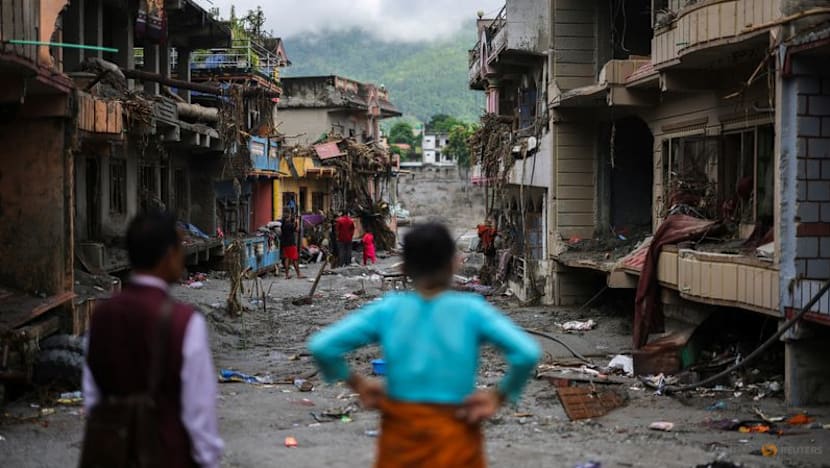
The disaster began on Aug. 26, when a glacial collapse sent ice, mud, rocks and fast-moving water through a valley, destroying settlements, bridges and power lines. At least 800 people died and more than 3,000 remain missing. Satellite analysis indicates that bedrock beneath a glacier collapsed, although scientists say it is too early to directly attribute the event to climate change. Warming can weaken permafrost that helps hold high-altitude slopes together.
China’s President Xi Jinping has called for faster surveys of glaciers and glacial lakes across the Tibetan Plateau. Nepal also faces a potentially lengthy recovery. Binod Chaudhary, the country’s only billionaire, estimated that damage could reach at least US$5 billion, with reconstruction taking as long as the seven to eight years needed after the 2015 earthquake.
Lack of trans-boundary data seeding mechanisms.
About this summary
Originally published by The Straits Times in English. Translated, summarized, and contextualized automatically by DistantNews, with a note on how the source frames the story. Not individually reviewed before publishing. How this works.
More Stories

From Our Blog

What Gets Lost (and Found) When News Is Translated

The Critical Role of Diaspora Media in Global News

What Travellers Should Know About Countries with Restricted Press

A Digital Nomad's Guide to Following Local News

How the Same Story Looks Different in Different Countries
