


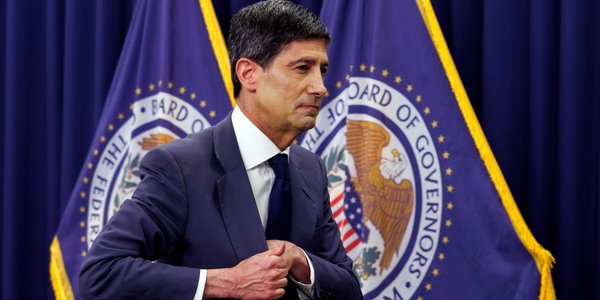
New Fed Chair Kevin Warsh Holds Rates Steady, Emphasizes Unpredictability
Translated from Polish, summarized and contextualized by DistantNews.
At a glance
News
Named sources
New plan
- The US Federal Reserve, under new Chair Kevin Warsh, held interest rates steady at its first meeting led by him.
- Warsh acknowledged that inflation exceeds the Fed's 2% target, acknowledging the burden on Americans, but offered no radical new tools to combat it.
- Analysts expect the Fed's monetary policy approach to remain largely unchanged, with market factors anticipated to help lower inflation in the future.
The U.S. Federal Reserve maintained its benchmark interest rate at its first meeting under new Chair Kevin Warsh, signaling a steady approach despite acknowledging elevated inflation.
We are aware that inflation is significantly above the Fed's long-term inflation target of 2 percent. It has been ongoing for over five years. Persistently high prices are a burden for Americans.
Warsh, speaking at his inaugural press conference after the Federal Open Market Committee (FOMC) meeting, stated, "We are aware that inflation is significantly above the Fed's long-term inflation target of 2 percent. It has been ongoing for over five years. Persistently high prices are a burden for Americans." However, he did not propose any drastic new measures or tools to tackle the rising costs.
Analysts, like Jakub Rybacki from mBank, do not anticipate a significant shift in the FOMC's monetary policy strategy simply because of the new leadership. Rybacki noted that while inflation is above the Fed's target, it hasn't reached levels severely impacting the U.S. economy. He attributed the current inflation partly to energy shocks that are expected to subside, predicting a milder price environment in the latter half of the year and into the next.
The inflation is indeed higher than the target set by the Fed, but these are still not levels that are very strongly felt by the American economy.
Market observers focused on Warsh's communication style during the press conference. Some Polish commentators viewed it as a potential shift, with the "first banker of the USA" potentially favoring a different approach to market communication. Kamil Szczepański, a financial market analyst at XTB, expressed concerns, stating, "The market had many concerns and low expectations for Warsh, but even those low expectations might have been too high. The problem is not the dovish or hawkish nature of the new chairman, the problem is communication." Szczepański added that Warsh "does not want or know how" to communicate effectively with the media and markets, which could pose challenges given his influential position.
The market had many concerns and low expectations for Warsh, but even those low expectations might have been too high. The problem is not the dovish or hawkish nature of the new chairman, the problem is communication.
Warsh is known for his reluctance to employ "forward guidance," a policy where central banks publicly announce their intentions regarding future monetary policy. This approach, used by the Fed and the Polish Monetary Policy Council for years, helps markets anticipate future interest rate movements, allowing investors and consumers to prepare for changes in borrowing costs. Warsh, however, reportedly believes that providing early signals to the market limits flexibility.
Warsh does not want or know how to communicate with the media and market, which can be a problem, considering he is now one of the most important people in the world of finance.
DistantNews Editorial
Originally published by Rzeczpospolita in Polish. Translated, summarized, and contextualized by our editorial team with added local perspective. Read our editorial standards.
More Stories


From Our Blog

What Gets Lost (and Found) When News Is Translated

The Critical Role of Diaspora Media in Global News

What Travellers Should Know About Countries with Restricted Press

A Digital Nomad's Guide to Following Local News

How the Same Story Looks Different in Different Countries
