


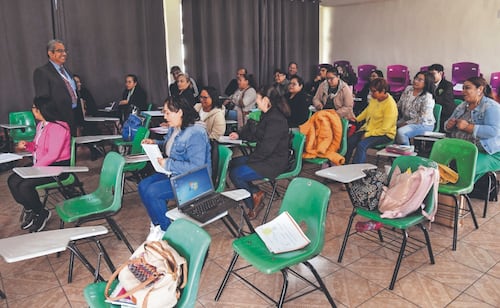
 Image: Archivo/ EL UNIVERSAL
New school year begins with more missed class days in 17 states, study warns
Translated from Spanish and summarized by DistantNews. Read the original for the full story.
At a glance
News
Documents & data
Context piece
- Mexico’s 2026-2027 school year begins with 34.37 million students, while 17 states have increased the number of suspended class days, according to a study by IEEC and México Evalúa.
- The analysis says funding for learning assessments fell 73.7% in one year, early education coverage stands at 3.73%, and upper-secondary dropout reaches 11.3%.
- It also reports that only 26 of every 100 students who enter primary school complete a university degree, while Mexico’s PISA 2022 mathematics score trailed the OECD average.
Mexico’s new school year begins with a warning that students are returning to a system marked by fewer effective class days and sharply reduced funding for evaluating learning. Seventeen states increased their number of suspended school days, according to an analysis by the Education with Equity and Quality Initiative at Tecnológico de Monterrey and México Evalúa.
The study, titled “Returning, staying, learning: Seven keys to the return to school 2026-2027,” examines class attendance, school trajectories, coverage, dropout, learning outcomes and education spending. It says resources devoted to assessing learning fell 73.7% in a single year.
The figures describe a system serving 34,370,623 students, with 2,180,559 teachers and 262,351 schools across basic, upper-secondary and higher education. Women make up 50.7% of enrollment and 61.2% of teaching staff. Basic education accounts for 23.36 million students, while upper-secondary education has 5.49 million and higher education 5.52 million.
The analysis also points to gaps in access and completion. Early education coverage is only 3.73%, and upper-secondary dropout reaches 11.3%. Only 26 out of every 100 students who begin primary school go on to complete a university degree. Mexican students scored 395 points in mathematics in PISA 2022, compared with 472 for the OECD average.
Education spending represents 10% of the federal budget, five percentage points below the minimum recommended by UNESCO. The 2026-2027 calendar sets 185 class days, five fewer than the previous figure cited in the study.
About this summary
Originally published by El Universal in Spanish. Translated, summarized, and contextualized automatically by DistantNews, with a note on how the source frames the story. Not individually reviewed before publishing. How this works.
More Stories


From Our Blog

What Press Freedom Means for the News You Read

What Gets Lost (and Found) When News Is Translated

The Critical Role of Diaspora Media in Global News

What Travellers Should Know About Countries with Restricted Press

A Digital Nomad's Guide to Following Local News
