


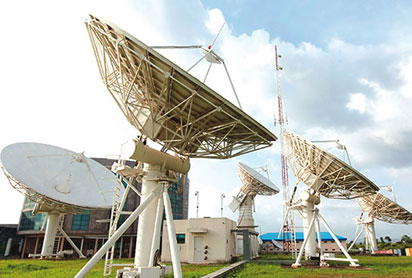
Nigeria Approves Two New Satellites to Boost Broadband Coverage
Translated from English, summarized and contextualized by DistantNews.
At a glance
News
Named sources
New plan
- Nigeria's Federal Executive Council approved the acquisition of two new NIGCOMSAT satellites to expand broadband coverage.
- The NIGCOMSAT-2A and NIGCOMSAT-2B satellites will extend connectivity to underserved areas and boost broadcasting and government services.
- This milestone aims to strengthen national communications resilience, reduce dependence on foreign infrastructure, and create jobs in the digital economy.
Nigeria's Federal Executive Council has approved the acquisition and deployment of two new high-throughput communication satellites, NIGCOMSAT-2A and NIGCOMSAT-2B. This move by the Nigeria Communications Satellite Limited (NIGCOMSAT) aims to significantly expand broadband coverage and bolster critical communications services across the nation.
This is a significant milestone for NIGCOMSAT and for Nigeria, and we commend President Bola Ahmed Tinubu for the leadership and support that have enabled us to reach this stage.
The new satellites are designed to extend connectivity to underserved, unserved, and hard-to-reach communities. They will also enhance broadcasting, enterprise connectivity, and government services, complementing existing terrestrial broadband networks. NIGCOMSAT stated that the deployment will strengthen national communications resilience and increase Nigeria's capacity for satellite-enabled services.
Jane Nkechi Egerton-Idehen, MD and CEO of NIGCOMSAT, hailed the approval as a "significant milestone" for the agency and the country. She commended President Bola Ahmed Tinubu for his leadership, emphasizing that the satellites will enhance national satellite capacity and support critical communications. The priority, she added, is to translate this investment into tangible value for Nigerians and position NIGCOMSAT for greater impact globally.
NIGCOMSAT-2A and NIGCOMSAT-2B will strengthen our national satellite capacity, expand connectivity and support critical communications across the country.
Beyond expanding connectivity, the initiative seeks to fortify secure and resilient communications for national security and defense. It also aims to reduce Nigeria's reliance on external satellite infrastructure. The deployment is expected to foster opportunities across the satellite and digital technology value chain, including telecommunications, broadcasting, and technical support. The next steps involve engaging technology partners and finalizing contracts for the satellites' manufacture, launch, and deployment, with Thales Alenia Space of France and Israel Aerospace Industries (IAI) as the expected providers.
Our priority is to translate this investment into measurable value for Nigerians and position NIGCOMSAT for stronger impact within the global satellite and digital economy.
DistantNews Editorial
Originally published by Vanguard in English. Translated, summarized, and contextualized by our editorial team with added local perspective. Read our editorial standards.
More Stories


From Our Blog

How the Same Story Looks Different in Different Countries

What Gets Lost (and Found) When News Is Translated

The Critical Role of Diaspora Media in Global News

What Travellers Should Know About Countries with Restricted Press

A Digital Nomad's Guide to Following Local News
