


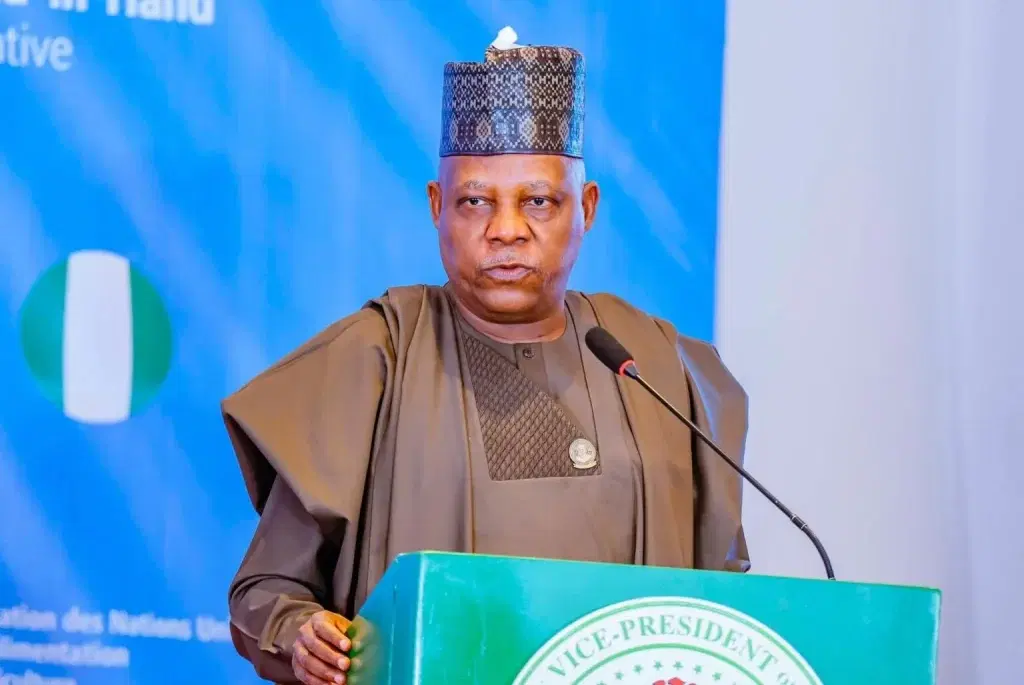
Nigeria's $1 trillion economic vision needs women's full participation: Shettima
Translated from English, summarized and contextualized by DistantNews.
At a glance
News
Named sources
New plan
- Nigeria's Vice President Kashim Shettima stated that achieving a $1 trillion economy is impossible without women's full participation.
- He launched four platforms to address the gender finance gap and empower women-led businesses.
- The initiatives aim to shift women from financial exclusion to productive economic roles, recognizing investment in women as a growth strategy.
Nigeria cannot reach its ambitious $1 trillion economic goal without the full participation of women, Vice President Kashim Shettima declared Wednesday. He launched four strategic platforms designed to bridge the gender gap in financial inclusion and transform women's economic potential into thriving enterprises and sustainable growth.
Speaking at the Second National Gender Inclusion Conference in Abuja, Shettima warned that the administration's economic target remains unattainable as long as women face structural barriers to finance, markets, and skills. "What kind of economy can we build if half of our people cannot participate fully in creating it?" he questioned, highlighting that only 47 percent of Nigerian women have formal financial accounts, compared to 58 percent of men.
We have set our sights on a one-trillion-dollar economy. But what kind of economy can we build if half of our people cannot participate fully in creating it?
This disparity means millions of women's businesses lack access to affordable capital, and their entrepreneurial potential remains largely untapped. Shettima emphasized that investing in women is not charity but a crucial growth strategy, stating, "The question is no longer whether we can afford to invest in women; it is whether we can afford not to. Our answer is no!"
The government is transitioning from policy pronouncements to an "architecture of delivery." Initiatives include the National Income Activation Initiative and the Women in Energy Partnership with the World Bank, aiming to connect women and youth to skills, capital, markets, and emerging economic opportunities. Shettima cautioned against relying solely on national averages, as aggregate figures can mask the continued exclusion of women in rural communities.
The question is no longer whether we can afford to invest in women; it is whether we can afford not to. Our answer is no!
DistantNews Editorial
Originally published by Vanguard in English. Translated, summarized, and contextualized by our editorial team with added local perspective. Read our editorial standards.
More Stories


From Our Blog

How the Same Story Looks Different in Different Countries

What Gets Lost (and Found) When News Is Translated

The Critical Role of Diaspora Media in Global News

What Travellers Should Know About Countries with Restricted Press

A Digital Nomad's Guide to Following Local News
