


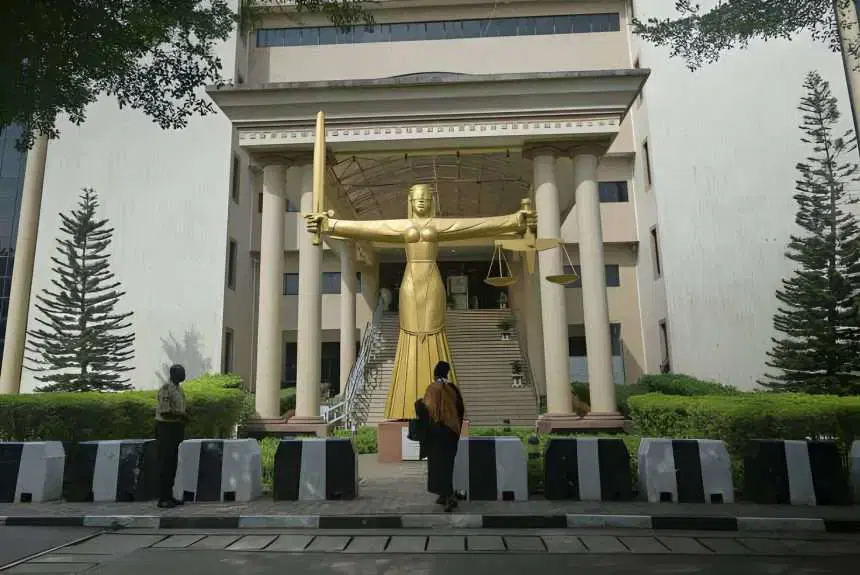
Nigeria's Federal High Court allows weekend filings for election cases
Translated from English, summarized and contextualized by DistantNews.
At a glance
News
Named sources
New plan
- Nigeria's Federal High Court will now accept pre-election litigation filings on weekends and public holidays.
- The new practice direction aims to expedite the resolution of election-related cases, addressing judicial delays.
- This move follows concerns raised by the Chief Justice of Nigeria about the speed and efficiency of the judiciary.
Nigeria's Federal High Court has introduced a new practice direction allowing the filing of pre-election cases on weekends and public holidays. This measure aims to tackle the surge in pre-election litigation and address delays in the judicial process, a concern recently highlighted by the Chief Justice of Nigeria.
Justice John Tsoho, the Chief Judge, repealed the 2022 practice directions and mandated that the court's registry remain open on Saturdays, Sundays, and public holidays between 10 a.m. and 2 p.m. exclusively for filing pre-election matters. This directive comes shortly after the Chief Justice, Justice Kudirat Kekere-Ekun, lamented the increasing delays in case adjudication, emphasizing that the judiciary's effectiveness is judged by its speed and efficiency.
Prior to the 2023 general elections, Justice Tsoho had established special panels to manage the high volume of cases, noting that some judges had over 1,000 pending cases. He previously criticized the Electoral Act of 2022 for increasing the court's responsibilities without providing corresponding support. The Electoral Act mandates that pre-election cases be concluded within 180 days of filing.
The Body of Senior Advocates of Nigeria has also called for a dedicated National Constitutional Court to handle all election-related cases, citing the numerous adjournments and the impact on fundamental rights enforcement suits due to the influx of political cases. The new Federal High Court Pre-Election Practice Directions, effective June 29, are designed to ensure the speedy, efficient, and fair determination of these critical matters.
This is notwithstanding the judges’ existing high-volume dockets, which present enormous challenges. It is necessary to place on record that the Electoral (Amendment) Act, 2022, was enacted without any consultation with the Court. Also, no support whatsoever was provided to address the increased responsibility. This weighed heavily on the operations of the Court.
DistantNews Editorial
Originally published by Vanguard in English. Translated, summarized, and contextualized by our editorial team with added local perspective. Read our editorial standards.
More Stories


From Our Blog

How the Same Story Looks Different in Different Countries

What Gets Lost (and Found) When News Is Translated

The Critical Role of Diaspora Media in Global News

What Travellers Should Know About Countries with Restricted Press

A Digital Nomad's Guide to Following Local News
