


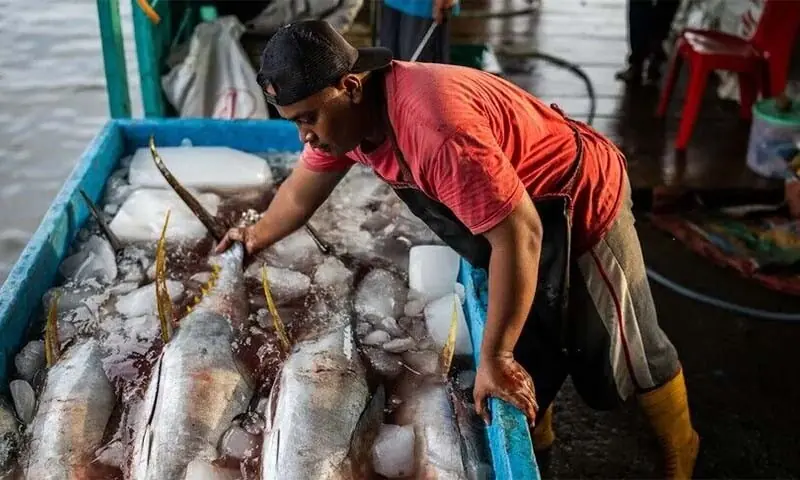
No catch for the day: Pakistan's tuna trade caught in US-Iran crossfire
Summarized and contextualized by DistantNews.
At a glance
News
Named sources
Ongoing story
- Pakistani fishermen are engaged in a risky barter trade, exchanging tuna for subsidized Iranian fuel in Iranian waters.
- Escalating US-Iran tensions and recent US airstrikes on Iranian seaports have severely disrupted this trade, making the region dangerous.
- The collapse of this trade threatens the livelihoods of thousands of Pakistani fishermen, as Iran is their only viable market for high-value tuna.
In the waters bordering Pakistan and Iran, a precarious trade is unfolding where Pakistani fishermen exchange high-value tuna for subsidized Iranian fuel. This barter system, once a lucrative arrangement, is now under severe threat due to escalating tensions between the United States and Iran, and recent US airstrikes on Iranian seaports.
Shah Zamin Khan, a Pakistani tuna trader, described how his business, like thousands of others, has been nearly paralyzed since February. The situation worsened significantly after the US targeted Iranian ports like Konarak, Pasabandar, and Beris, which are crucial hubs for the fish trade and lie near Pakistan's Balochistan province. "Our businesses were already affected by the war, but the recent targeting of Iranian seaports has turned the region into a no-go area for us over the past one month," Khan told Anadolu.
Our businesses were already affected by the war, but the recent targeting of Iranian seaports has turned the region into a no-go area for us over the past one month.
Fear of US strikes has led boat owners to halt all expeditions to Iranian ports. Tragically, an attack in July on a commercial fishing pier in Iran's Sirik city resulted in the deaths of three Pakistani fishermen and injuries to 15 others. Earlier, in March, a 17-year-old Pakistani fisherman was killed when debris from an intercepted projectile hit his vessel in the Arabian Sea.
For Pakistani fishermen, Iran represents the only significant market for tuna, which fetches prices six to seven times higher there than in Pakistan, where demand is minimal. "There is not even a single company in Pakistan to buy our tuna. Iran is the only option for us," said Hussain Baloch, another fisherman. He warned that without access to the Iranian market, the entire tuna fishery faces collapse, jeopardizing the income and employment of thousands. The disruption also impacts Pakistan's boat-building industry, which has seen a drastic decline in new orders from Iran.
There is not even a single company in Pakistan to buy our tuna. Iran is the only option for us.
DistantNews Editorial
Originally published by Dawn. Summarized and contextualized by our editorial team with added local perspective. Read our editorial standards.
More Stories

From Our Blog

What Gets Lost (and Found) When News Is Translated

The Critical Role of Diaspora Media in Global News

What Travellers Should Know About Countries with Restricted Press

A Digital Nomad's Guide to Following Local News

How the Same Story Looks Different in Different Countries
