


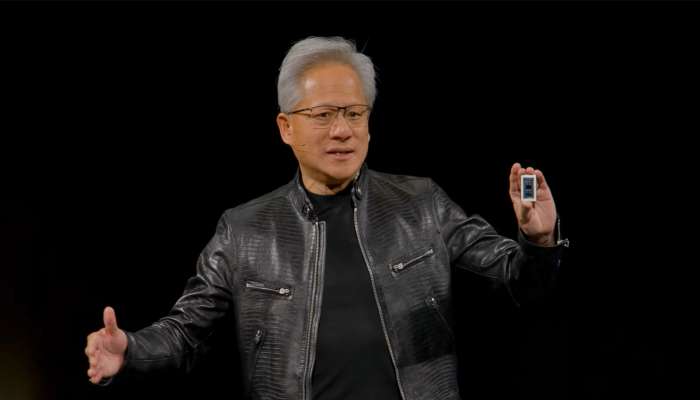
NVIDIA CEO Jensen Huang disagrees with Bill Gates on AI's impact on jobs
Translated from English and summarized by DistantNews. Read the original for the full story.
At a glance
News
Sources not specified
Context piece
- NVIDIA CEO Jensen Huang believes AI will ultimately create more jobs than it eliminates, contradicting concerns raised by Bill Gates.
- Huang acknowledges AI will significantly change jobs across industries, leading to some eliminations but also creating new roles.
- He argues that increased productivity from AI will drive company growth and hiring, with compute capacity being the current constraint on AI development.
NVIDIA CEO Jensen Huang has offered a more optimistic outlook on the impact of artificial intelligence on the job market, directly contrasting with concerns voiced by Bill Gates. While Gates has warned of AI potentially displacing millions of jobs, Huang asserts that AI will be a "net job creator" in the long run.
Everybody's jobs will be changed because of AI. My job has changed. And some jobs will be eliminated, many new jobs will be created.
"Everybody's jobs will be changed because of AI. My job has changed. And some jobs will be eliminated, many new jobs will be created," Huang stated in an interview. He drew parallels to past technological advancements, expressing confidence that AI's overall effect on employment will be positive. However, he stressed the need for society to be "sensible," "sensitive," and "supportive" in managing the disruption caused by AI.
I believe again that this will be a net job creator.
Huang further argued that enhanced productivity driven by AI would not necessarily lead to job cuts. Instead, he posited that more productive and profitable companies would reinvest in growth, leading to increased hiring. "When companies are more productive, they don't lay off people, they hire more people... the reason for that is because companies have ambitions," he explained.
When companies are more productive, they don't lay off people, they hire more people...the reason for that is because companies have ambitions, most companies do, and I would say the vast majority of the world's companies do.
The NVIDIA chief highlighted the growing commercial utility of AI, noting strong demand for AI services. He identified compute capacity as the primary bottleneck limiting AI's expansion, rather than a lack of customers or technological capability. Huang called for increased computing power to support AI labs and pointed to the widespread adoption of AI by enterprises and various cloud platforms globally.
AI has become useful. It's doing productive work and it's doing productive tasks and the tokens that these AI labs are generating are profitable tokens. And when you're generating something profitable and the demand is so extraordinary, you want to generate more of it. So the thing that's limiting their growth today is not customers, is not their technology, customers are the demand is incredible, what's holding it back now is just compute.
About this summary
Originally published by Times of Oman in English. Translated, summarized, and contextualized automatically by DistantNews, with a note on how the source frames the story. Not individually reviewed before publishing. How this works.
More Stories



From Our Blog

What Gets Lost (and Found) When News Is Translated

The Critical Role of Diaspora Media in Global News

What Travellers Should Know About Countries with Restricted Press

A Digital Nomad's Guide to Following Local News

How the Same Story Looks Different in Different Countries
