


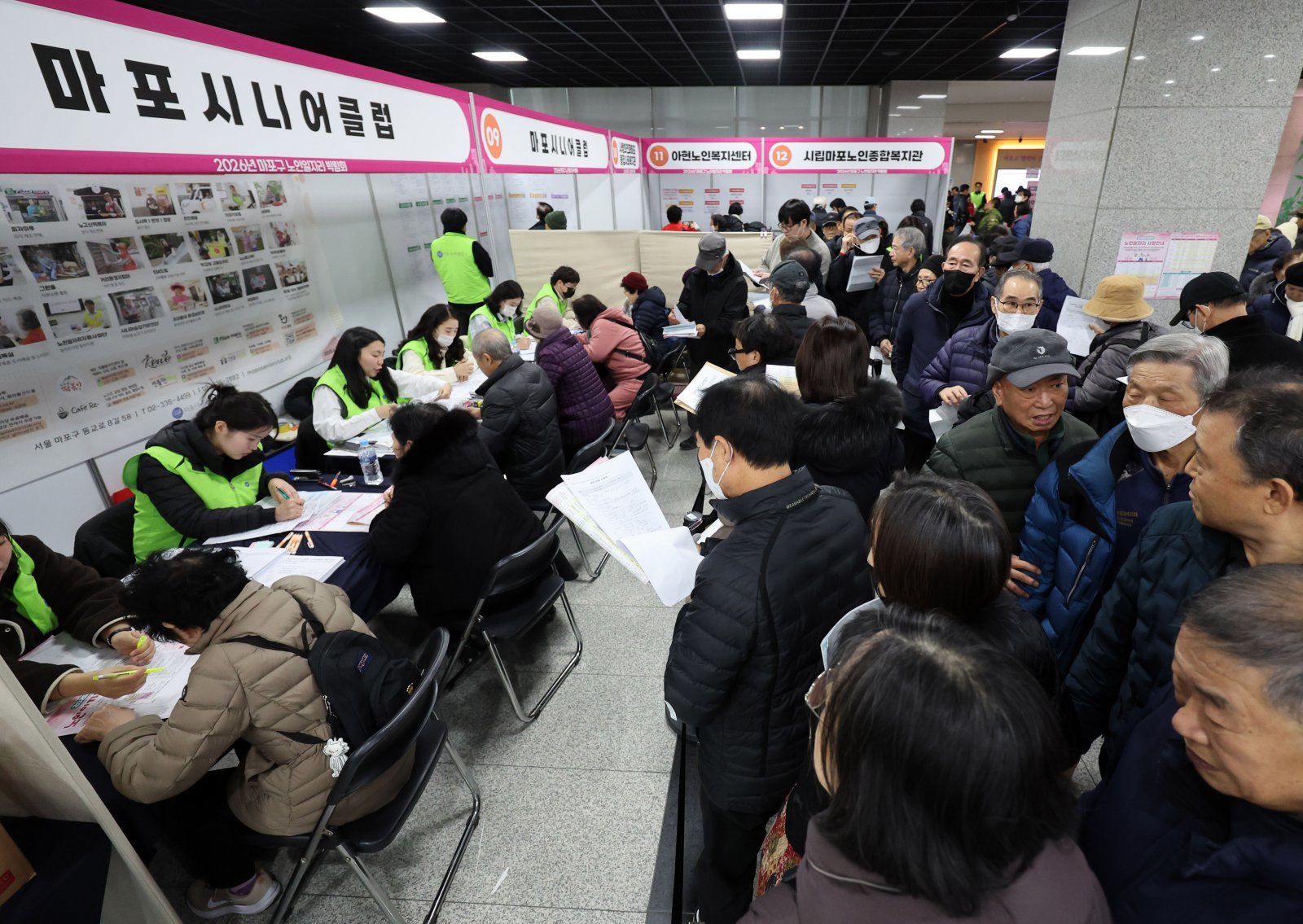
One in five job seekers in South Korea is over 60, second only to 20-somethings
Translated from Korean, summarized and contextualized by DistantNews.
At a glance
News
Named sources
Context piece
- One in five job seekers in South Korea is over 60, making them the second-largest age group of job seekers after those in their 20s.
- Young job seekers prefer management and office roles, while older job seekers favor caregiving, cleaning, and security positions.
- Experts recommend tailored employment strategies for different age groups, focusing on high-value jobs for the young and improving working conditions for the elderly.
South Korea's job market is seeing a significant surge in older job seekers, with individuals in their 60s representing 19.3% of all job applicants, according to a report by the Korea Employment Information Service. This demographic is the second-largest group seeking employment, following closely behind those in their 20s.
The report analyzed data from 4.14 million job seekers in 2024. Those in their 20s accounted for the largest share with 998,678 applicants. The 60s group followed with 799,242 applicants, then the 50s (785,729), 30s (706,900), 70s (96,261), and those under 20 (49,277).
This indicates a trend where younger job seekers concentrate on specific fields, while older workers are more dispersed across various sectors.
Preferences for job types differ starkly between age groups. Job seekers in their 20s overwhelmingly favor management and office administration roles, making up 24.9% of their applications. Arts and broadcasting (11.6%) and IT research and development (8.6%) are also popular. In contrast, the 60s demographic shows a stronger preference for caregiving roles (16.8%), followed by cleaning (15.5%) and security (9.0%). This indicates a trend where younger job seekers concentrate on specific fields, while older workers are more dispersed across various sectors.
Salary expectations also vary. While 56.4% of 20-somethings seek a monthly salary between 2 to 3 million won, only 36.3% of those in their 60s share this expectation. However, older job seekers are more inclined towards hourly or daily wage positions, with 31.1% preferring this compared to just 5.1% of 20-somethings. Researchers suggest that employment policies need to be differentiated by age. For younger individuals, the focus should be on matching them with stable jobs that offer growth potential. For older workers, improving the working conditions and providing retraining for caregiving, cleaning, and security roles is crucial. The analysis emphasizes the need for life-cycle-specific employment strategies, offering diverse career choices and development support for the young, and ensuring employment stability for the elderly.
The focus should be on matching them with stable jobs that offer growth potential. For older workers, improving the working conditions and providing retraining for caregiving, cleaning, and security roles is crucial.
DistantNews Editorial
Originally published by Dong-A Ilbo in Korean. Translated, summarized, and contextualized by our editorial team with added local perspective. Read our editorial standards.
More Stories


From Our Blog

What Gets Lost (and Found) When News Is Translated

The Critical Role of Diaspora Media in Global News

What Travellers Should Know About Countries with Restricted Press

A Digital Nomad's Guide to Following Local News

How the Same Story Looks Different in Different Countries
