

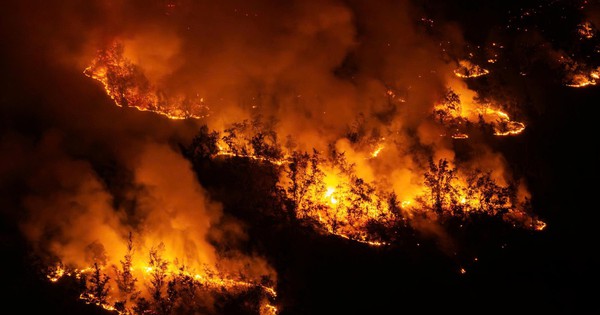
Over 500 people, 14 fire trucks fight coastal protective forest fire in Gia Lai
Translated from Vietnamese, summarized and contextualized by DistantNews.
At a glance
News
Named sources
Outcome reported
- Over 500 personnel and 14 fire trucks are battling a wildfire that has consumed approximately 30 hectares of coastal protective forest in Gia Lai province, Vietnam.
- The fire, which started on July 20, reignited due to strong, shifting winds after initial containment efforts.
- Firefighters have established firebreaks to control the spread, with the affected area primarily consisting of casuarina, cashew, and acacia trees.
More than 500 people and 14 fire trucks have been mobilized in Vietnam's Gia Lai province to combat a wildfire that has scorched about 30 hectares of coastal protective forest in Phu My Dong commune. The blaze, which initially erupted on the afternoon of July 20, saw an immediate response from around 70 individuals, including forest rangers, police, and local forces, who worked to create firebreaks. However, strong and unpredictable winds caused the fire to reignite around 11 p.m. that night, overcoming the initial containment lines. On July 21, combined forces from forest management, the military, police, and local militias continued firefighting efforts. Gia Lai province dispatched 14 fire engines and numerous personnel to the scene, bringing the total mobilized force to over 500. Local authorities used loudspeakers and communication channels to warn residents against entering the affected area for their safety and urged nearby households to prepare for potential evacuation. By the morning of July 22, firebreaks encircling the burned area had been largely completed, successfully containing the fire and preventing it from spreading to adjacent forestland. The affected forest primarily comprises casuarina, cashew, and acacia trees. Firefighting operations were hampered by strong, shifting winds that fanned the flames and spread embers. Prolonged hot weather dried out the undergrowth, making the forest highly flammable, particularly the resin-rich casuarina trees which fueled the rapid spread of the fire.
DistantNews Editorial
Originally published by Thanh Niên in Vietnamese. Translated, summarized, and contextualized by our editorial team with added local perspective. Read our editorial standards.
More Stories

From Our Blog

What Gets Lost (and Found) When News Is Translated

The Critical Role of Diaspora Media in Global News

What Travellers Should Know About Countries with Restricted Press

A Digital Nomad's Guide to Following Local News

How the Same Story Looks Different in Different Countries
