


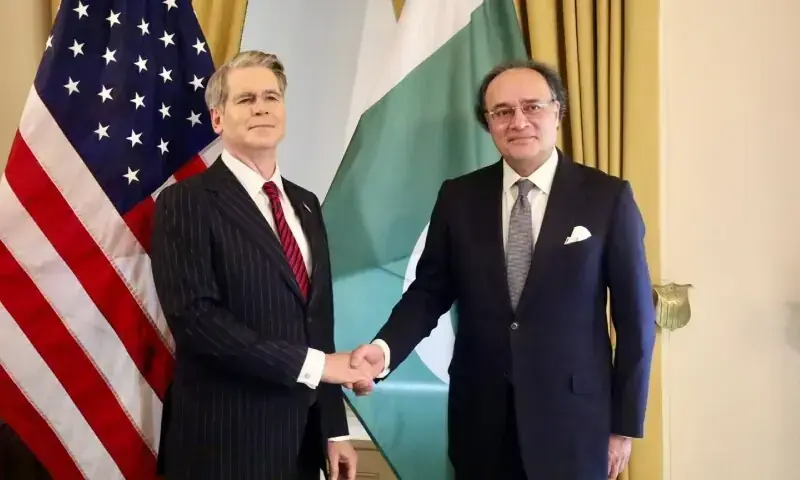
Pakistan seeks $10 billion US stabilization fund to ease financial pressure
Translated from English, summarized and contextualized by DistantNews.
At a glance
News
Named sources
New plan
- Pakistan's finance minister requested a $10 billion Exchange Stabilisation Support Facility from the US Treasury during a recent Washington visit.
- The facility, a direct bilateral financial tool, aims to help Pakistan manage external financing pressures, including foreign exchange reserves and debt obligations.
- While it could provide crucial liquidity, experts caution it's a bridge to stability, not a substitute for necessary structural economic reforms.
Pakistan is seeking a $10 billion Exchange Stabilisation Support Facility from the US Treasury, a powerful but rarely used financial tool, as it grapples with ongoing external financing pressures. Finance Minister Muhammad Aurangzeb made the request during a recent visit to Washington, seeking a facility with a maturity period of up to five years.
an important financial buffer
The proposed arrangement represents a direct bilateral financial mechanism between the US and Pakistan, distinct from traditional assistance from multilateral lenders. Such a facility could provide Pakistan with much-needed liquidity to manage its foreign exchange reserves, meet international debt obligations, and stabilize its currency market. This comes as Pakistan continues to face significant balance-of-payments challenges.
If approved, the Exchange Stabilisation Fund (ESF)-backed facility could bolster the State Bank of Pakistan's ability to handle external payment pressures, including import financing and debt servicing. It could also enhance market confidence in Pakistan's capacity to meet its international commitments. A former IMF economist noted that such a facility could offer an "important financial buffer" amid geopolitical uncertainties and volatile oil prices, which leave Pakistan vulnerable due to its energy import dependence.
At a time of heightened geopolitical uncertainty in the Middle East and continued volatility in global oil prices, Pakistan remains vulnerable because of its dependence on imported energy. A stronger reserve position would enable the State Bank of Pakistan to better manage exchange-rate volatility, meet external debt obligations and cushion temporary external shocks without disrupting economic activity.
However, experts caution that the facility should be viewed as a temporary measure. A former IMF economist advised that it serves as "a bridge to stability rather than a substitute for structural reforms." Pakistan must still address long-term economic issues, including broadening its tax base, expanding exports, improving productivity, and exercising fiscal discipline by curbing non-essential public spending. The approval hinges on Washington's assessment of the request and the agreement on the structure and conditions of the assistance.
a bridge to stability rather than a substitute for structural reforms
DistantNews Editorial
Originally published by Dawn in English. Translated, summarized, and contextualized by our editorial team with added local perspective. Read our editorial standards.
More Stories

From Our Blog

What Gets Lost (and Found) When News Is Translated

The Critical Role of Diaspora Media in Global News

What Travellers Should Know About Countries with Restricted Press

A Digital Nomad's Guide to Following Local News

How the Same Story Looks Different in Different Countries
