

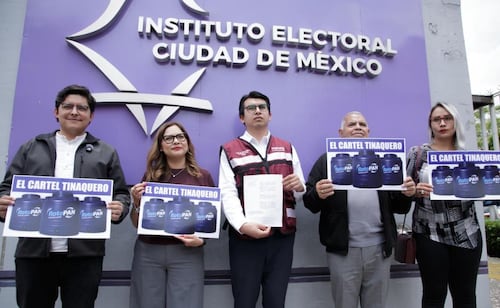

PAN demands Mexico City Congress approve Territorial Ordering Law, citing six years of delay
Translated from Spanish, summarized and contextualized by DistantNews.
At a glance
News
Sources not specified
Context piece
- The local PAN party in Mexico City demands the Congress approve the Territorial Ordering Law, which has been pending for six years.
- PAN accuses the ruling Morena party of neglecting the law, citing a lack of consultation and resources, and continuing to use an outdated 2010 law.
- The party warns that this legislative inaction creates legal loopholes, legal uncertainty, and violates the rights of indigenous communities to participate in territorial management.
The National Action Party (PAN) is urging the Mexico City Congress, currently dominated by Morena, to pass the long-delayed Territorial Ordering Law. PAN CDMX President Luisa Gutiérrez criticized the lack of progress, stating that Morena's approach has prevented the creation of a law essential for city planning. She highlighted that as the parliamentary majority, Morena holds responsibility for the legislative agenda and government bodies.
Gutiérrez pointed out that Morena and its allies have failed to prioritize the Territorial Ordering Law in their legislative agendas for 2024, 2025, and 2026. She noted the absence of mandatory consultations and the lack of allocated resources to fulfill legal requirements. Federico Döring, a federal deputy and PAN CDMX spokesperson, added that the local Congress should have enacted this law in 2018, coinciding with the city's new constitution.
Döring expressed frustration that two legislative terms will pass without advancement. He criticized the government for spending public funds on cosmetic projects, like the "ajolotization" of the city, instead of addressing the law. He found it ironic that the axolotl, a symbol of the city, is embraced while consultations with Indigenous Peoples and Barrios are neglected for the Territorial Ordering Law.
The PAN highlighted significant legal and social consequences stemming from this legislative omission. These include a legal vacuum, as the outdated 2010 Urban Development Law, incompatible with the 2017 constitutional framework, remains in effect. This also leads to legal uncertainty, with academic experts warning that current planning instruments lack adequate legal support, potentially fostering real estate corruption. Furthermore, the party argued that the rights of Indigenous Peoples and Barrios to participate in territorial management are being violated due to the lack of mandated consultations.
DistantNews Editorial
Originally published by El Universal in Spanish. Translated, summarized, and contextualized by our editorial team with added local perspective. Read our editorial standards.
More Stories

From Our Blog

What Press Freedom Means for the News You Read

What Gets Lost (and Found) When News Is Translated

The Critical Role of Diaspora Media in Global News

What Travellers Should Know About Countries with Restricted Press

A Digital Nomad's Guide to Following Local News
