


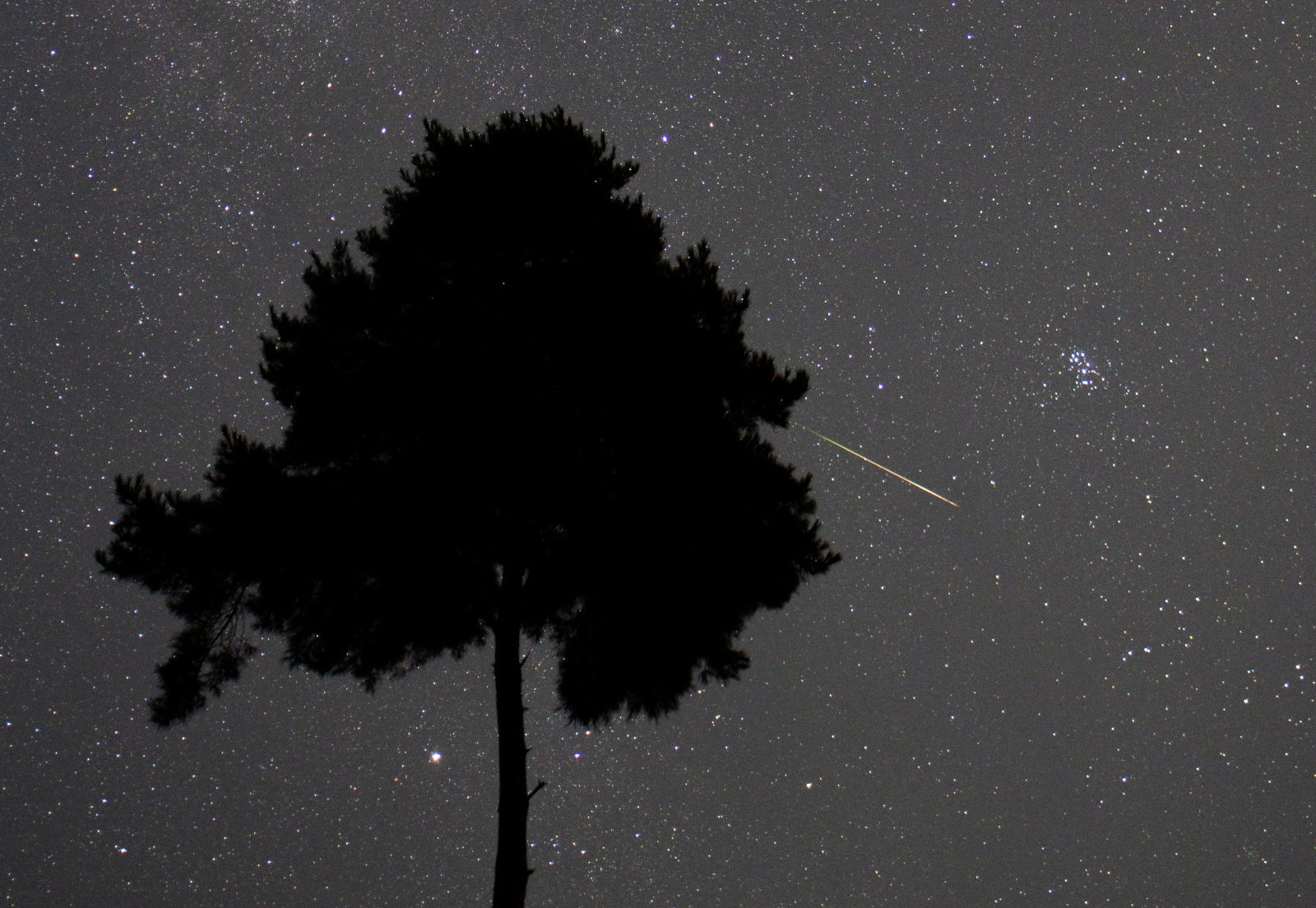
Perseid meteor shower peaks, gracing midsummer night skies
Translated from Korean, summarized and contextualized by DistantNews.
At a glance
News
From a news agency
Context piece
- The Perseid meteor shower reached its peak on August 13, offering a spectacular celestial display visible in South Korea.
- Ideal viewing conditions are expected through the morning of August 14 due to the absence of moonlight.
- Observers can expect up to 100 meteors per hour under optimal conditions, though actual numbers may vary.
South Korea's night sky was illuminated by the Perseid meteor shower, a prominent summer astronomical event, which reached its peak on August 13. The celestial show offered a dazzling display of shooting stars streaking across the heavens.
According to the Korea Astronomy and Space Science Institute, the meteor shower's activity peaked around noon on August 13. While the peak occurred during daylight hours, the shower's activity continues, making the nights of August 13 and the early morning of August 14 prime times for observation. The institute identified these two mornings as the best period for viewing this year.
This year's Perseid meteor shower is particularly favorable for viewers due to minimal interference from moonlight. The new moon occurred on August 13, meaning the moon was in the same direction as the sun and did not illuminate the night sky. In the following days, the moon will appear as a thin crescent and set early, further enhancing viewing conditions throughout the night.
Under ideal circumstances, observers could witness up to 100 meteors per hour. However, this figure is a theoretical maximum (ZHR) assuming perfect conditions: clear skies, minimal light pollution, and the radiant point of the shower ideally positioned. Actual observed numbers will likely differ based on location and local weather.
The Perseid meteors enter Earth's atmosphere at approximately 59 kilometers per second. The dust and small rock fragments left behind by the comet 109P/Swift-Tuttle, the shower's parent comet, create the streaks of light we see as shooting stars. The name "Perseids" comes from the constellation Perseus, as the meteors appear to radiate from a point near it, known as the radiant.
DistantNews Editorial
Originally published by Dong-A Ilbo in Korean. Translated, summarized, and contextualized by our editorial team with added local perspective. Read our editorial standards.
More Stories



From Our Blog

What Gets Lost (and Found) When News Is Translated

The Critical Role of Diaspora Media in Global News

What Travellers Should Know About Countries with Restricted Press

A Digital Nomad's Guide to Following Local News

How the Same Story Looks Different in Different Countries
